For Whom the Bell Tolls First Edition 1940: Points, Jacket States, Value
Hemingway Firsts
Ernest Hemingway, one of America's most beloved authors, is always in demand among book collectors. Titles like The Old Man and the Sea, A Farewell to Arms, and For Whom the Bell Tolls can fetch thousands of dollars depending on condition and edition. Fortunately, for the serious collector, true first editions are generally identifiable — if you know what to look for.
Scribner's, Hemingway's longtime publisher, used a relatively consistent set of identifying marks across his major titles, though the specific points vary from book to book. Here's what to look for on the titles collectors most frequently seek.
For Whom the Bell Tolls (1940)

There are a few reliable points of issue for the first edition, first printing.
The copyright page should indicate a date of 1940 with no subsequent printings noted, and that date should match the title page. Some later editions state 1940 on the copyright page but carry a later year at the bottom of the title page — a red flag worth catching.
The copyright page should also carry either the letter "A" printed on its own line beneath the "All rights reserved" disclaimer, or the Scribner's Sons colophon — but not both. The absence of either indicates a later printing.
The dust jacket is equally important. A true first printing jacket carries a price of $2.75 on the front flap and no photographer credit beneath Hemingway's portrait on the rear panel.
A Farewell to Arms (1929)
The true first edition of A Farewell to Arms was actually a limited edition — 510 copies, signed by Hemingway and issued in a slipcase. For most collectors, however, the first trade edition is the realistic target.
The first trade edition states 1929 on the bottom of the title page, with a matching 1929 copyright date on the copyright page and the Scribner's seal at the bottom of that page. Within the first trade edition, there is a meaningful first issue point: the first issue lacks a legal disclaimer on page x that appears in all later printings. That disclaimer reads: "None of the characters in this book is a living person, nor are the units or military organizations mentioned actual units or organizations. —E. H." If that disclaimer is present, you have a later printing.
The dust jacket offers two additional points. The front flap price should be $2.50. More strikingly, the first issue jacket contains a typo — the character Catherine Barkley is misspelled as "Katherine Barclay" on the front flap. It's one of the more memorable jacket errors in American first edition collecting, and its presence is a strong positive indicator.
The Old Man and the Sea (1952)
Published by Scribner's in 1952, The Old Man and the Sea carries both the letter "A" and the Scribner's seal on the copyright page for the first printing. Given the novel's enormous first print run — roughly 50,000 copies — true firsts are more accessible than many Hemingway titles, though fine copies still command significant premiums.
The dust jacket presents an interesting wrinkle. Two variant jackets exist: one with Hemingway's back-panel photograph tinted blue, and one where the photo appears olive. This variation is believed to result from printing inconsistencies rather than deliberate production decisions, and neither variant takes precedence over the other as a point of issue. Both are equally valid first edition jackets. A signed copy, as with all Hemingway titles, commands a substantial premium.
The Sun Also Rises (1926)
The earliest of Hemingway's major novels and among the most sought-after. The first edition title page matches the 1926 copyright date, and the copyright page carries the Scribner's seal with no mention of subsequent printings. The book is bound in black cloth with gold paper labels.
Two additional points are worth knowing. First, a textual error: the word "stopped" is misspelled as "stoppped" on page 181, line 26 — three p's rather than two. Its presence confirms a first printing. Second, the dust jacket front panel reads "IN OUR TIMES" — a reference to Hemingway's earlier story collection — which was corrected to "IN OUR TIME" in later issues. The misspelled jacket is a first issue point.
Across the River and Into the Trees (1950)
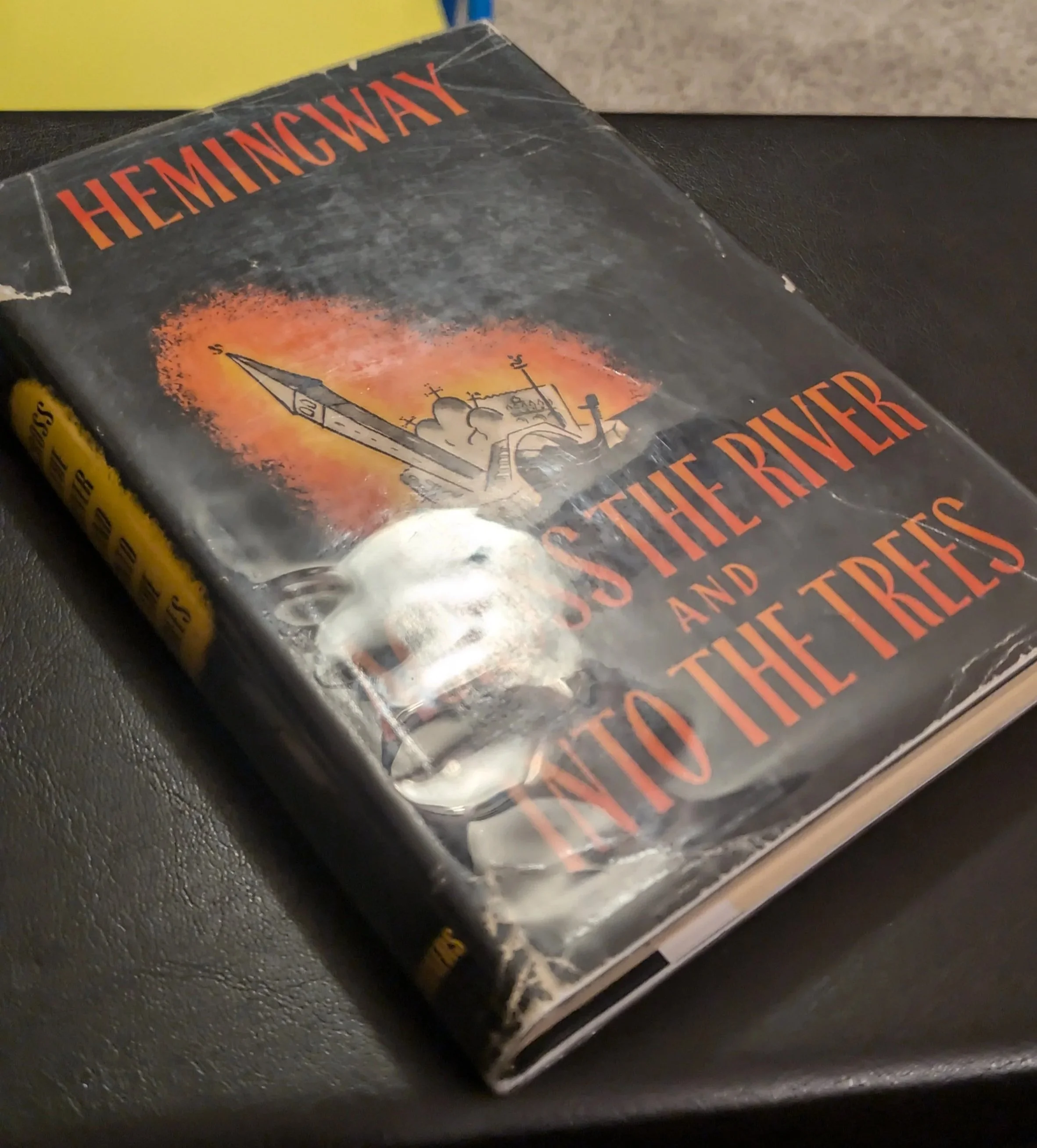
Less celebrated than Hemingway's earlier masterworks but a genuine collector's title. The first American edition, published by Scribner's, carries the letter "A" and the Scribner's colophon on the copyright page.
The dust jacket offers a clean distinguishing point: the first issue carries yellow spine lettering, while later issue jackets use orange. Worth knowing when evaluating any copy.
There's an added wrinkle for advanced collectors: the British edition, published by Jonathan Cape, is generally believed to have preceded the American Scribner's edition by a few days. Despite this, the American edition — particularly a fine copy with the yellow-lettered jacket — remains the more sought-after, likely because Hemingway's primary publishing relationship was with Scribner's and American collectors dominate the market for his work. Additionally, Scribner's produced 25 presentation copies that preceded all other editions entirely, though these rarely surface on the open market.
A Note on Dust Jackets
Across Hemingway's Scribner's output, the dust jacket is consistently the most value-determining physical element. A fine copy of For Whom the Bell Tolls in a fresh first printing jacket commands multiples of what the same book brings without one. Collectors should treat jacket condition as equal in importance to the book itself, and examine jacket prices, flap copy, and rear panel details carefully on any copy under consideration. That cuts both ways, and it is worth seeing what an honestly graded jacket fault looks like on a Scribner first. Our copy of A Moveable Feast, Scribner's 1964 first edition has a price clipped flap, disclosed and photographed, with the copyright page code carrying the identification instead.
At The Quill and Parchment, we examine every Hemingway title we handle with exactly this level of scrutiny. Browse our current Hemingway inventory, or reach out directly if you're looking for a specific title — we're always scouting.