Dune by Frank Herbert: Identifying the True First Edition (And Why the BCE Is Worth Owning Too)
Frank Herbert's Dune is one of sci-fi's most well-known works, but in terms of rare book collecting, it's an outlier. The true first edition is a rare specimen, commanding many thousands of dollars, which is why the Book Club Edition also holds value for collectors.

One of the more collectable SF books, Frank Herbert’s Dune.
Published in 1965 by Chilton Books — yes, the same publisher better known for automobile repair manuals — Dune went on to win both the Hugo and Nebula Awards and become the best-selling science fiction novel of all time. A true first edition, first printing is among the holy grails of science fiction book collecting, with fine copies commanding prices well into five figures.
But Dune is also one of the most deceptive books in the hobby. Unlike most novels, where a book club edition is relatively easy to spot and set aside, Herbert's Dune presents a genuine identification challenge — one that has fooled experienced collectors and even some dealers. If you're trying to identify a first edition of Dune, or determine whether what you're holding is a true Chilton first or a Science Fiction Book Club edition, here's what you need to know.
Why Dune Is Different From Other First Editions
When I'm evaluating a potential BCE, the copyright page is usually my first stop. Most book club editions either omit the "First Edition" statement entirely or add language identifying a subsequent printing. With Dune, the copyright page is still worth examining — but it requires more caution than usual.
The true first printing of the Chilton edition states "First Edition" on the copyright page and lists only the year 1965, with no additional dates. Later Chilton printings can be identified by a number line on the copyright page indicating the printing number. So far, straightforward enough.
Here's where it gets complicated. Because the Science Fiction Book Club printed its edition from the same plates as the Chilton trade first, the BCE copyright page can be nearly identical to the true first. Most BCE copies omit the "First Edition" statement — but not all. Some BCE printings retain it. This means that the presence or absence of "First Edition" on the copyright page cannot be treated as a reliable identifier in either direction. A collector who bases their conclusion on the copyright page alone is on shaky ground, regardless of what it says.
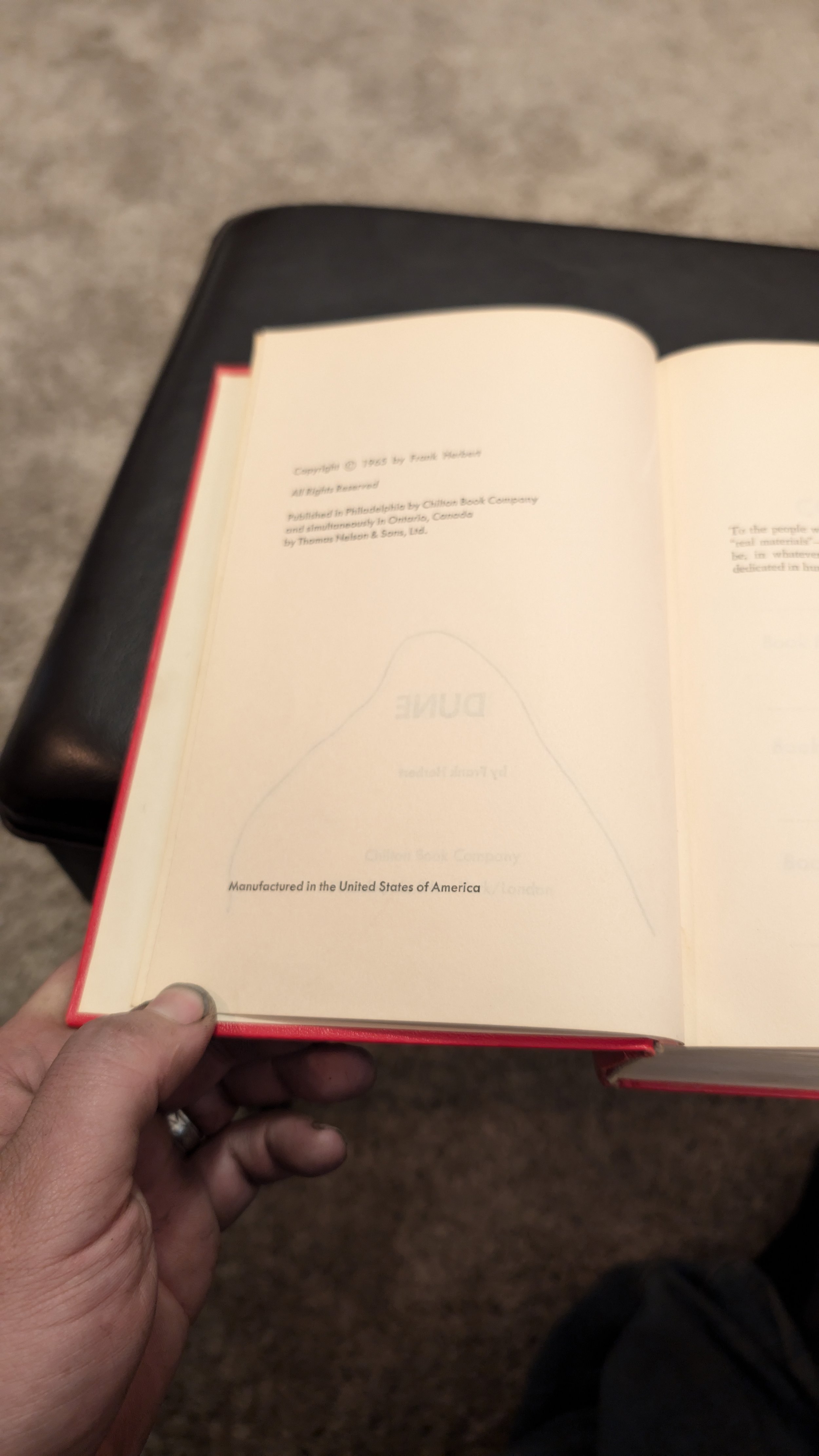
This book club edition of “Dune” shows a copyright date with no subsequent printings. However, the lack of a first edition statement identifies it as a BCE.
The copyright page, in other words, is a starting point — not a verdict.
How to Identify a True First Edition of Dune
The dust jacket is where the real identification work happens. The true Chilton first edition dust jacket carries a price of $5.95 on the front flap. The Science Fiction Book Club edition carries no price — standard practice for book club editions. However, because both jackets share the same iconic design by artist John Schoenherr, they can look nearly identical at a glance. That $5.95 price on the front flap is doing a lot of work, and it's the detail you cannot afford to overlook.
To summarize the copyright page points: a true first printing shows "First Edition" and the year 1965 with no other dates. If the copyright page shows a number line indicating a fifth or later printing, you have a later Chilton printing, not a true first. But given the BCE variability described above, the jacket price remains your most authoritative single point of issue.
How to Read the Dune BCE Gutter Code
There is one additional tool available when evaluating a potential BCE. The Science Fiction Book Club edition carries a small stamped alphanumeric gutter code at the foot of the final text page — a printer's tracking mark used to identify book club print runs. No such code appears in the true Chilton first. If you find a gutter code, you have a BCE, full stop, regardless of what the copyright page shows.

The sought-after “47M” gutter code.
The complete checklist for a true Chilton first printing: "First Edition" stated on the copyright page, 1965 as the only date, no number line, the $5.95 jacket price on the front flap, and no gutter code on the final text page. Each point reinforces the others. If any one of them is off, dig deeper before drawing a conclusion.
The BCE Exception: Why the Dune Book Club Edition Is Worth Owning
Here's where Dune breaks another rule of collecting.
In general, BCEs are considered significantly less valuable than trade first editions — a book club edition of most novels might fetch a few dollars while the true first commands hundreds or thousands. Dune is one of the rare exceptions where the Science Fiction Book Club edition has developed genuine collector value in its own right.

“Book Club Edition” is clearly marked on the dust jacket, but that doesn’t automatically make it less valuable.
The reason is simple: the true Chilton first edition of Dune is extraordinarily scarce and extraordinarily expensive. With fine copies selling for $10,000 to $25,000 or more, the vast majority of collectors will never own one. The BCE — printed in larger numbers and therefore more available — has become the attainable alternative for the serious science fiction collector who wants an original 1965 printing of the novel on their shelf. A Dune BCE in fine condition with a clean dust jacket can fetch $150 to $400, and exceptional copies have sold for considerably more. That's real money for a book club edition, and it reflects genuine demand from collectors who know exactly what they have.
It also doesn't hurt that the BCE, printed from the same plates, reads exactly like the true first and features the same Schoenherr jacket art. For the reader-collector, it's a deeply satisfying object.
The Bottom Line: Buying and Identifying Dune First Editions
Dune rewards careful, methodical examination. Don't rely on any single point of issue — and don't assume the copyright page tells the whole story. Check the copyright date, look for the $5.95 jacket price, verify the absence of a number line, and search the final text page for a gutter code. When all of those points align, you have strong grounds for confidence. When even one of them doesn't, keep looking.
At The Quill and Parchment, we examine every copy of Dune we encounter with exactly this process. We don't currently have a Chilton first in stock — but if you're actively looking for one, we'd like to hear from you. Email us to tell us what you're after, and we'll be in touch when the right copy comes through. We're always scouting. And be sure to check out our BCE of “Dune” with the 47M gutter code in our store.