Building a Golden Age Science Fiction Collection Without Breaking the Bank: Five First Editions Under $100
Starting a book collection can be daunting if you've not researched collectible books. The prices some titles command can be a barrier for collectors. The marquee titles of Golden Age science fiction — the ones with famous names and famous covers — can run into the thousands or tens of thousands of dollars for a fine copy. For a newer collector, those prices can make the hobby feel out of reach before it even begins.
But here's what the serious collectors already know: the Golden Age of science fiction wasn't built by three men. It was built by dozens of writers, editors, and publishers working in a period of extraordinary creative energy, producing books that shaped the genre's DNA and influenced every science fiction writer who came after them. Many of those books are still available in true first edition for under $100 — and they're every bit as historically significant as the titles with the big price tags.
New collectors often ask why these collectible first edition books, while more affordable, still cost more than brand new books. The answer is twofold: supply and demand, and historical significance.
Why Collectible First Editions Cost More Than New Books
A new hardcover from a major publisher is, by definition, a commodity. It's printed by the tens or hundreds of thousands, available in every bookstore and on every online retailer, and its supply will never be meaningfully scarce. If you want a copy five years from now, you'll find one easily.
A Golden Age science fiction first edition is something fundamentally different. Many of these books were published by small specialty presses — Gnome Press, Fantasy Press, Shasta Publishers — in print runs of 2,000 to 5,000 copies at most. That was the entire first printing. Of those original copies, many were read to pieces, lost, damaged by water or time, or simply discarded by people who didn't recognize what they had. The ones that survive in collectible condition represent a genuinely finite and shrinking supply.
You're not paying for the words on the page — you can read most of these stories in inexpensive paperback reprints. You're paying for the physical artifact: a specific object produced at a specific moment in history, in limited quantity, that has survived intact for seven decades. That object has a story, a provenance, and a scarcity that a new hardcover will never have.
There's also a practical investment dimension worth noting. As fine copies of these titles become harder to find, their value tends to appreciate. The serious collector who bought a fine Gnome Press first edition twenty years ago almost certainly paid less than today's market price. That trend is unlikely to reverse.
That said, the best reason to collect these books isn't financial. It's the genuine thrill of holding a piece of science fiction history — an object that was new when the genre was new, that sat on the shelves of the readers who first encountered these ideas, and that has made it to your hands largely intact. That's worth something that a Barnes and Noble receipt can't capture.
Five Golden Age Science Fiction First Editions Worth Collecting
Judgment Night by C.L. Moore — Gnome Press First Edition (1952) — $38

C.L. Moore is one of the most important writers in the history of science fiction and fantasy, and one of the most underrepresented in serious collections. She broke into the pulps in 1933 with “Shambleau,” a story so strange and so assured that it announced a major talent on arrival, and she spent the next two decades producing work that her contemporaries borrowed from freely.
“Judgment Night” collects some of her finest writing from the 1940s, including the title novella — a sweeping, elegiac story of empire and inevitability that holds up as well as anything from the era. Gnome Press brought it into hardcover in 1952, when the pulps had been the only venue for this kind of work, and Moore's Gnome titles are among the more elusive in a serious collection. This copy is the boards binding, the lower-priority issue per Currey, and it is an honest good/good copy — real shelfwear, real jacket chipping, all of it photographed in the listing. At $38 it is a reading copy and a placeholder rather than a shelf centerpiece, which is exactly what a young collection needs while you wait for a finer example to surface.
The Vortex Blaster by E.E. "Doc" Smith — Gnome Press First Edition (1960) — $38

E.E. "Doc" Smith was the father of the space opera. His Lensman universe set the template for every galactic empire that followed — the scale, the stakes, the sense of cosmic adventure that defines the genre at its most expansive. Without Doc Smith, there is no Star Wars.
“The Vortex Blaster” was published by Gnome Press in 1960, one of the final titles from a press that would close two years later. That late-period Gnome provenance makes it a historically interesting acquisition — you're holding one of the last books from one of the most important publishers in science fiction history. At $38, it's an accessible entry point into both the Doc Smith bibliography and the Gnome Press collecting universe.
The Legion of Time by Jack Williamson — Fantasy Press First Edition (1952) — $32

Jack Williamson had one of the longest careers in science fiction history — he published his first story in 1928 and his last in 2005, spanning nearly eight decades of the genre's evolution. “The Legion of Time” is classic Williamson: time travel, parallel worlds, and the kind of propulsive plotting that made Golden Age SF so compulsively readable.
The Fantasy Press first edition is a particularly desirable object for collectors. Fantasy Press, founded by Lloyd Arthur Eshbach, was known for producing some of the finest quality hardcovers of the Golden Age — better paper, better binding, better production values than most of its contemporaries. A Fantasy Press first edition is a beautiful thing to hold, and at $32 this one represents exceptional value.
Pattern for Conquest by George O. Smith — Gnome Press First Edition (1949) — $40
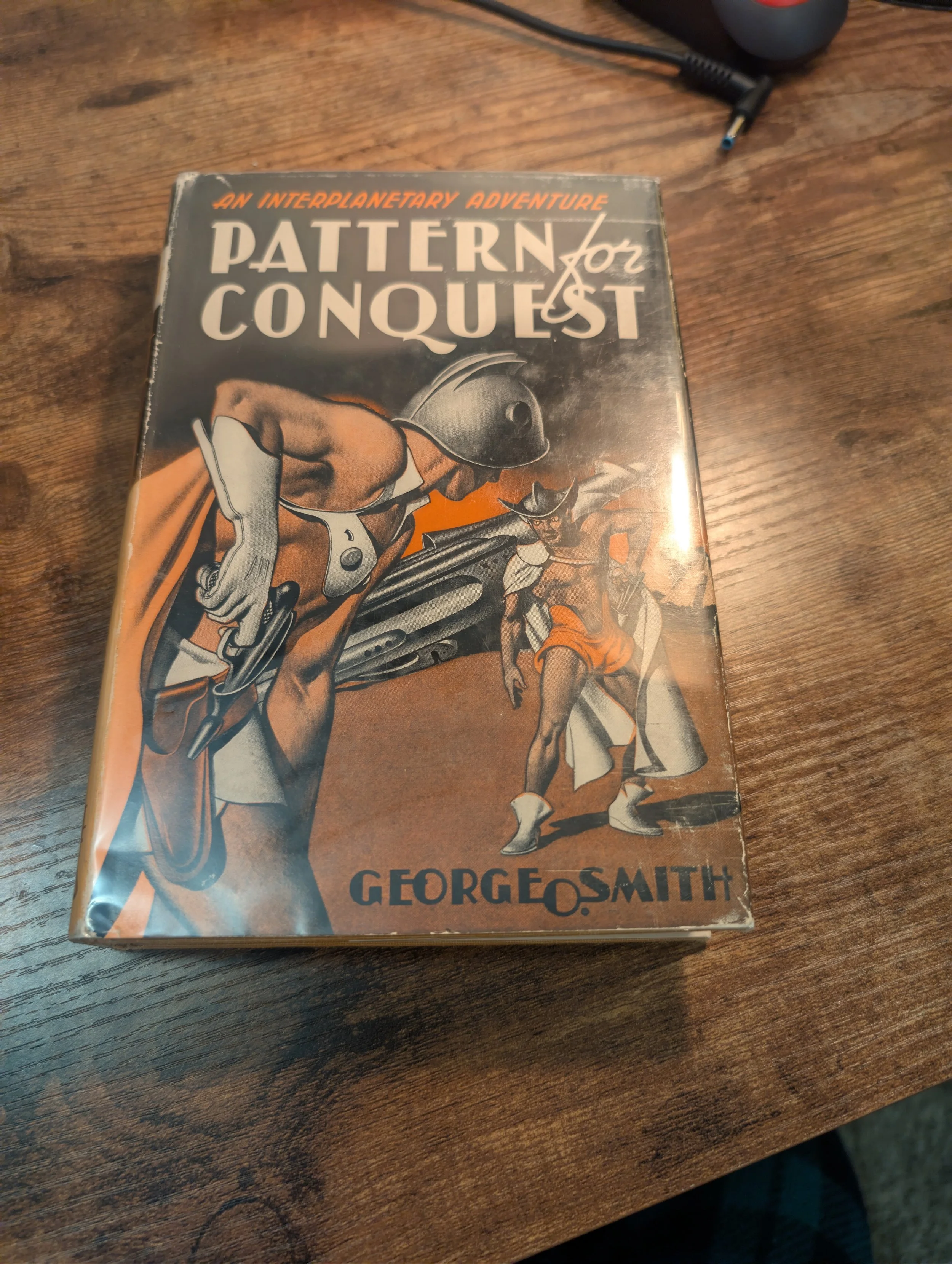
George O. Smith built his reputation in the pages of “Astounding Science Fiction,” where his Venus Equilateral stories made him one of the defining voices of Golden Age hard SF. His confidence that any problem — even a civilizational one — yields to clear thinking and technical mastery is the period in miniature.
“Pattern for Conquest” was among his earliest appearances in hardcover, published by Gnome Press in 1949 and following humanity through its first interstellar war. Chalker and Owings record a total print run of 5,000 copies, of which 2,000 were an armed forces paperback issue — putting the hardcover trade edition at roughly 3,000. That is a small number for a book this central to the period. The jacket art is by Edd Cartier, whose work more or less defines the look of early Gnome Press, and this copy retains it unclipped with the original $2.50 price intact. At $40, an intact Cartier jacket is most of the value on its own.
The Red Peri by Stanley G. Weinbaum — Fantasy Press First Edition (1952) — $55
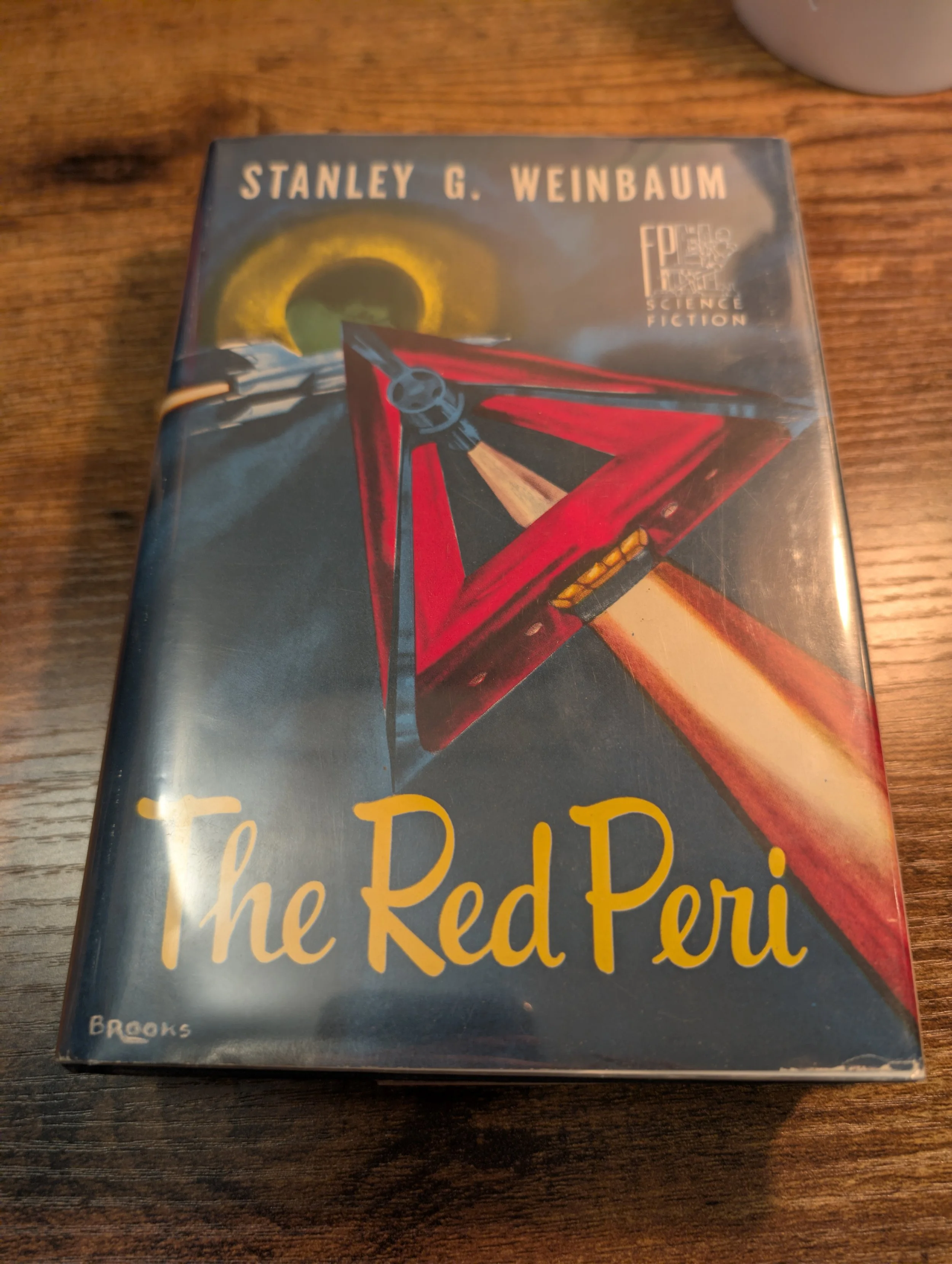
Stanley G. Weinbaum left behind about a year and a half of published work before his death, and nearly all of it survives in two posthumous Fantasy Press collections. His debut, “A Martian Odyssey,” is generally credited with showing the pulps that an alien could be genuinely alien rather than a monster or a man in a costume — writers from Asimov onward pointed back to it as the moment the field grew up.
“The Red Peri” is one of those two collections, and it leads with the title novella, an interplanetary adventure built around one of Weinbaum's characteristically capable female leads. This is the 1952 trade issue in black cloth stamped in gold, with “First Edition” stated on the copyright page. The book is Near Fine and the jacket Near Fine and price-clipped — clean, bright, square, unrestored, with the feel of a copy read once if at all. At $55 that is a great deal of condition for the money. One caution for the specialist: Currey records six bindings for this title in priority order, and the listing sets out in detail where this copy sits.
Where to Start
If you're building a Golden Age science fiction collection and aren't sure where to begin, any of these five titles would serve you well. Each is a verified first edition with documented points of issue, each represents a meaningful piece of the genre's history, and each is priced to be accessible without being disposable.
At The Quill and Parchment, every book we sell comes with detailed bibliographic documentation explaining exactly what makes it a first edition and why it matters. We don't just tell you a book is a first edition — we show you. That's what makes the difference between a book and a collectible.
Browse our current Golden Age Science Fiction inventory here.
Interested in learning more about Gnome and Fantasy Press? Read our posts about those small presses. And, you may also be interested in our post about The Golden Age of Science Fiction.