How Lloyd Eshbach Built Fantasy Press, and What It Means for Collectors Today
The Mailing List That Built a Publisher
Before there was a Fantasy Press, there was a mailing list. In the mid-1940s, Lloyd Arthur Eshbach was a veteran of early SF fandom, a writer who had published fiction in the pulps since the 1930s, and a man who had watched the small press world with particular attention. He had even helped a young William Crawford financially during Crawford's early publishing efforts. When Eshbach encountered Tom Hadley's struggling Buffalo Book Company, he saw both a problem and an opportunity.
Hadley, according to Jack Chalker and Mark Owings in The Science-Fantasy Publishers, had no idea how to market books. His original partners, Don Grant and Ken Krueger, had departed. When Eshbach stepped in to help, organizing the mailing list and handling correspondence, he inadvertently found himself fielding complaints from the Better Business Bureau over Hadley's undelivered orders. He received nothing for his trouble, except the mailing list itself.
That list turned out to be worth a great deal. It contained roughly a thousand names of people who had actually paid three dollars for Hadley's edition of E.E. "Doc" Smith's The Skylark of Space, a book Chalker and Owings note was "a period piece even at that time." If a dated pulp-era novel with no marketing could sell a thousand copies to identifiable buyers, Eshbach understood what that implied about Smith's newer, better work, none of which had yet appeared in hardcover.
And so in late 1946, Fantasy Press was formed in Reading, Pennsylvania. Eshbach served as director, with G.H. MacGregor as sales manager, A.J. Donnell as art director, and an accountant named L.H. Houck rounding out the partnership. None of the others were SF people. They were associates from Eshbach's work on the Glidden Paint house magazine, and they saw the venture as a profitable sideline. Eshbach sent out a mailing for the first title, Smith's Spacehounds of IPC, and advance orders came in fast enough to cover the entire printing and binding bill before a single copy was bound. The partners' total investment, as Chalker and Owings put it, was essentially letterhead and postage.
Doc Smith, Heinlein, and the Fantasy Press Catalog
E.E. "Doc" Smith was the anchor of the Fantasy Press list, and with good reason. His Lensman series and Skylark books were among the most beloved properties in science fiction, and none of them had appeared in hardcover. Eshbach published the full Skylark sequence, beginning with Skylark Three and Skylark of Valeron in 1948, and then moved through the Lensman series in order: Galactic Patrol and First Lensman in 1950, Gray Lensman in 1951, Second Stage Lensmen in 1953, and Children of the Lens in 1954. The 1955 six-volume boxed set The History of Civilization, collecting the complete Lensman sequence in leather-backed cloth with unprinted acetate jackets, stands as the press's most ambitious production.
Robert Heinlein appeared on the Fantasy Press list twice. Beyond This Horizon in 1948 was Heinlein's first hardcover book publication, and Assignment in Eternity followed in 1953. Both titles, like virtually every Fantasy Press book, were issued in two forms: a trade edition and a signed, numbered limited of 500 copies with an inserted limitation leaf. That limited edition program was consistent across the entire press run, and it is one of the signatures of the imprint for collectors today.
The catalog also included titles by Jack Williamson, Eric Frank Russell, A.E. van Vogt, Murray Leinster, and others who defined the Golden Age, alongside Eshbach's own fiction. John W. Campbell, the editor whose work at Astounding Science Fiction had shaped much of the genre's Golden Age, appeared in the Fantasy Press list as well. The breadth of the catalog, combined with the quality of production, set Fantasy Press apart from most of its contemporaries.
The One-Man Operation
By 1950, Eshbach had bought out his partners. The others had never been SF people, and their disinterest eventually showed. Eshbach financed the buyout in part by selling his personal SF collection, and he assumed complete control of the press. He supplemented the operation with a storefront used bookshop called The Book Shelf, which began primarily as a way to manage growing stock but evolved into a mail order business in new and used American and British SF. He sold the shop in late 1952 and moved to a farm outside Reading, by which point Fantasy Press was his sole livelihood. Chalker and Owings note that it wasn't a luxurious one, with supplemental income coming from a book stall at the local farmer's market once a week.
The arrangement also included a subsidiary rights deal with Pyramid Books for mass market paperback editions, which helped extend the reach of the titles and generated additional income. Eshbach's last significant year of production was 1955, when the broader collapse of the SF magazine market and the rise of mass market paperbacks began undermining specialty publishers across the board. Like Gnome Press, Fantasy Press was chronically undercapitalized, and the combination of falling sales and rising production costs made it impossible to sustain the pace. After 1955, only three more titles appeared, mostly to fulfill obligations to existing customers. Eshbach sold unbound sheets to Donald Grant, Buffalo/Hadley's former partner, who continued binding and selling them for years.
Collecting Fantasy Press: What to Look For
Fantasy Press books are among the most physically handsome of the specialty press era. Eshbach hired skilled artists including Ric Binkley, Edd Cartier, and Hannes Bok for jacket art, and the production quality was consistently higher than most of his contemporaries could manage. For collectors, the key identification points center on binding variants, jacket states, and the signed limited editions.
The Smith Lensman titles illustrate the binding variant challenge well. Galactic Patrol (1950) carries the most complex binding sequence of any Fantasy Press title, with ten recorded variants. According to L.W. Currey's Science Fiction and Fantasy Authors, the priority binding is blue cloth with spine lettered in gold, followed by a long sequence of later bindings in red cloth, red boards, gray boards, blue boards, light blue cloth, gray cloth, cream cloth, orange pebbled boards, and finally gold foil wrappers lettered in black. The first binding is the one to find; everything else represents later binding of remaining sheets. Second Stage Lensmen (1953) runs five bindings, with blue cloth lettered in gold as the first priority. Children of the Lens (1954) runs six, again opening with blue cloth lettered in gold.
The pattern is consistent enough to serve as a useful rule of thumb: for the Doc Smith Lensman titles at Fantasy Press, blue cloth lettered in gold is the first binding. When you see red boards, tan cloth, gray boards, or any of the other variants, you're looking at a later binding of sheets from the same printing, not a separate edition, but the collector market prices them accordingly.
Dust jacket priority matters as much as binding. For First Lensman (1950), Currey records two jacket states in priority order: the earlier jacket advertises four Smith titles on the rear panel, while the later jacket advertises five. For Gray Lensman (1951), the priority jacket advertises three Lensman titles on the rear panel; the later jacket advertises five books by other authors including Campbell, Leinster, and Russell. On the Heinlein titles, Beyond This Horizon has a known variant jacket printed in blue, which Eshbach himself confirmed was produced when the original jacket supply ran out, with approximately 100 copies printed. Currey is explicit that this blue jacket is a later state, not a proof.
The signed limited editions deserve special mention. Across nearly the entire Fantasy Press catalog, 500 copies of each title were set aside with a numbered and signed limitation leaf inserted. On some titles prepared specifically for Smith's personal use, the limitation leaf was replaced with an unprinted leaf, which occasionally surfaces. These limited copies carry a consistent premium over the trade issue, and because the limitation leaf is inserted rather than bound in, condition of the leaf itself is a factor worth examining in any copy offered as a limited.
The FPCI Confusion, Revisited
A note on a collector trap that warrants repeating: Fantasy Press is not Fantasy Publishing Company, Inc. The two publishers operated during the same period, both focused on science fiction, and the name similarity has caused misidentification in seller listings ever since. Fantasy Press was Eshbach's Reading, Pennsylvania operation. Fantasy Publishing Company, Inc., known as FPCI, was based in Los Angeles. Both produced collectible books, but they are distinct presses with distinct catalogs, and a listing that conflates the two is a listing that hasn't been properly researched.
We currently have copies of FPCI's The Rat Race by Jay Franklin in inventory alongside our Fantasy Press titles, which makes for an instructive side-by-side comparison of the two imprints' production styles.
What's in the Shop

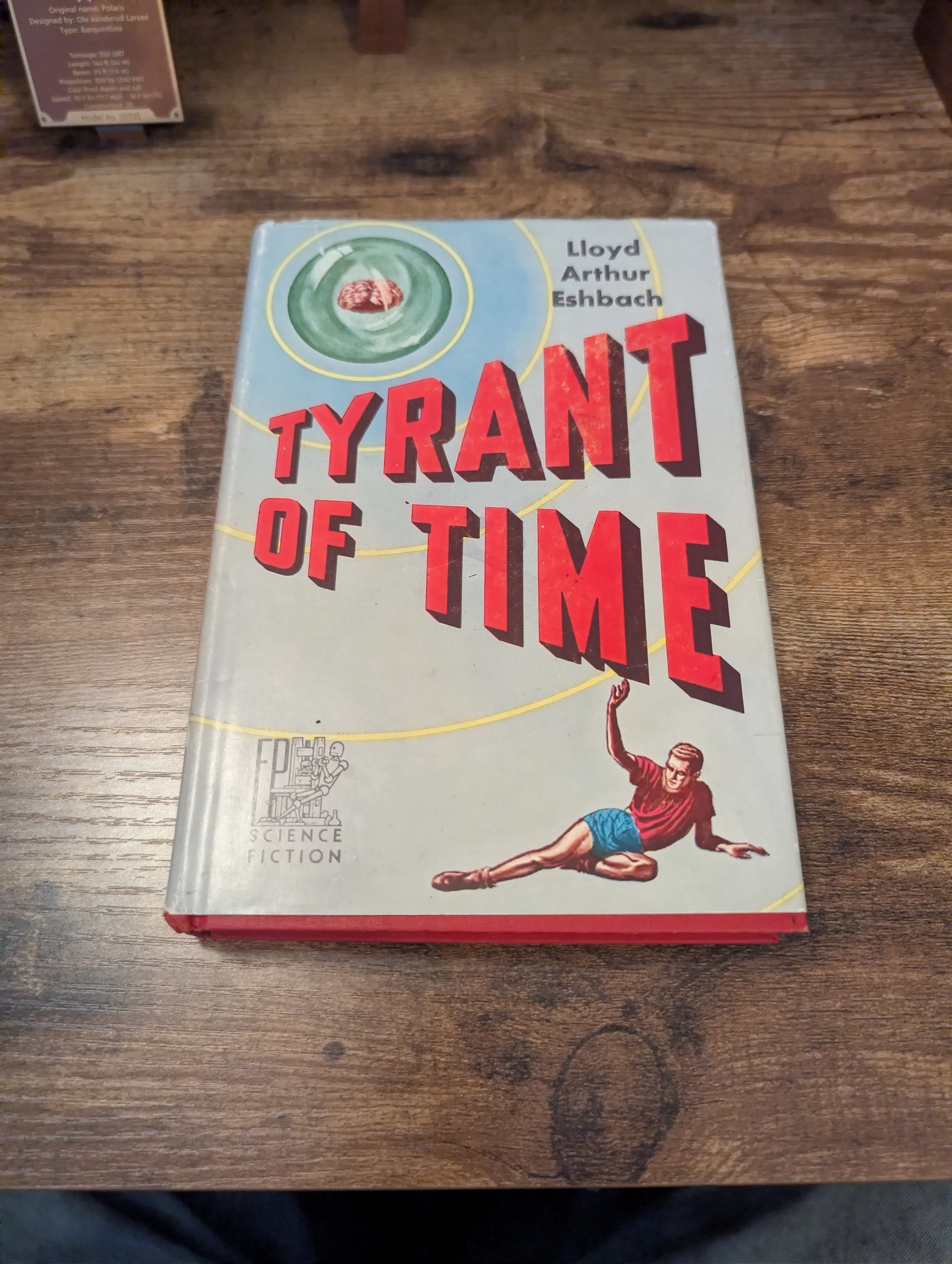
We carry Fantasy Press titles when we can find them in honest condition at prices that make sense. Currently in inventory: Gray Lensman by E.E. "Doc" Smith, the 1951 Fantasy Press first edition; Masters of Time by A.E. van Vogt, the 1950 Fantasy Press first; Dreadful Sanctuary by Eric Frank Russell, the 1951 Fantasy Press first in an association copy with Ken Johnson's signature; The Legion of Time by Jack Williamson, the 1952 Fantasy Press first; and The Tyrant of Time by Lloyd Eshbach himself, the 1955 first edition with red boards and gilt spine lettering. Each listing includes bibliographic documentation of binding state and jacket points. Browse the full
We carry Fantasy Press titles when we can find them in honest condition at prices that make sense. Currently in inventory: Gray Lensman by E.E. "Doc" Smith (Fantasy Press, 1951), Masters of Time by A.E. van Vogt (Fantasy Press, 1950), Dreadful Sanctuary by Eric Frank Russell (Fantasy Press, 1951, association copy), The Legion of Time by Jack Williamson (Fantasy Press, 1952), and The Tyrant of Time by Eshbach himself (Fantasy Press, 1955). Each listing documents binding state and jacket points. Browse the full Science Fiction & Fantasy inventory at thequillandparchment.com/store/science-fiction.
If you have a Fantasy Press title you're trying to identify, a photo of the boards, spine, and copyright page goes a long way. Get in touch and we're glad to take a look.
For more on the specialty press era, see our history of Gnome Press, and our earlier introduction to Fantasy Press.