The Red Peri Binding Problem: When Currey and Chalker and Owings Disagree
Many Fantasy Press titles from the early 1950s are straightforward to identify. The copyright page states first edition, the binding matches the standard issue, and the references agree with each other. The Red Peri is not one of those titles. Stanley Weinbaum’s collection, published by Fantasy Press in 1952, sits at the center of a genuine disagreement between the two reference works most Golden Age collectors reach for first. Currey describes one production history. Chalker and Owings describe another. The two accounts cannot both be complete, and the gap between them is exactly where a careful buyer can get tripped up.
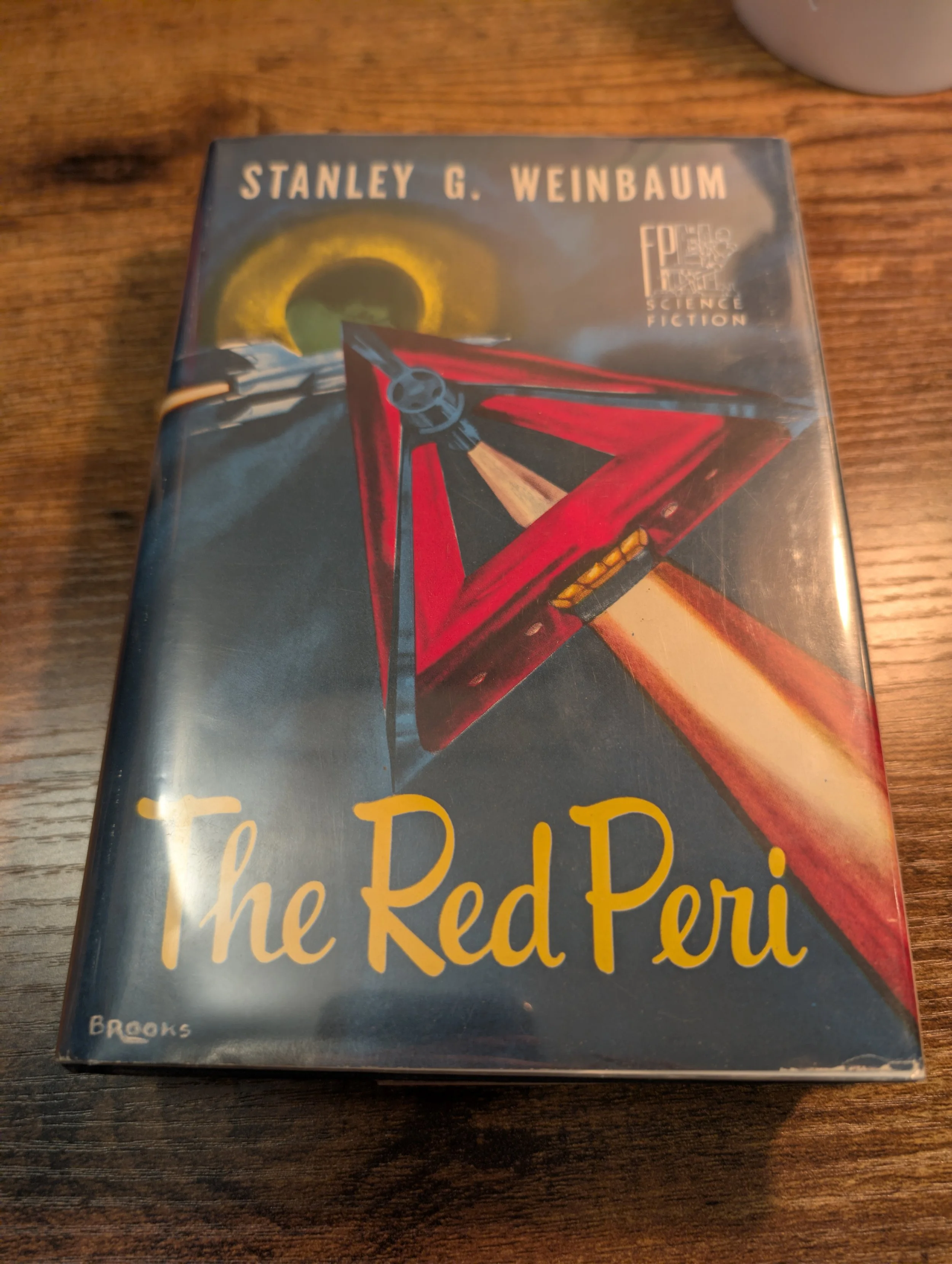
The book, briefly
Stanley G. Weinbaum was one of the most influential short story writers of early science fiction, despite a career that lasted barely eighteen months before his death in 1935. The Red Peri gathers several of his stories, and the Fantasy Press hardcover is the edition collectors want. The copyright page carries a first edition statement, and Fantasy Press issued the book in two forms: a numbered limited issue of 300 copies with a tipped-in limitation leaf, and a trade issue without it. Currey assigns no priority between the two, so neither outranks the other as the first edition. That part is settled. The bindings are where it comes apart.
What Currey records
Currey documents six bindings for The Red Peri and places them in priority order, which is itself unusual for a Fantasy Press title. In sequence: (A) black cloth with the spine stamped in gold, RED PERI set in 24 point type; (B) salmon cloth stamped in black; (C) brown cloth stamped in gold; (D) blue cloth stamped in black; (E) red boards stamped in black; and (F) black cloth stamped in gold, RED PERI set in 18 point type. That last binding is the one to watch. Currey identifies it as a Donald M. Grant binding produced around 1980 in imitation of the priority (A) binding. The two black cloth bindings look nearly identical at a glance. The tell is the size of the spine lettering, 24 point on the original against 18 point on the later Grant version.

What Chalker and Owings records
Chalker and Owings tell a different story. Their account puts the hardcover run at roughly 1,732 copies across four cloth variants, and it does not single out a second black cloth binding by type size at all. In their telling, the Grant bindings belong to brown cloth and were part of the original distribution handled through Eshbach rather than a 1980 reproduction, and the blue cloth represents a Greenberg remainder binding. They record no red boards variant.
Where the accounts collide
Set side by side, the disagreements are specific. Currey lists six bindings; Chalker and Owings list four. Currey treats one black cloth binding as a circa 1980 Grant imitation distinguished by 18 point lettering; Chalker and Owings record no such second black cloth binding and frame Grant’s involvement as original distribution in brown cloth. Currey includes a red boards variant that Chalker and Owings do not mention. These are not rounding errors. They are two reference works describing the same book and arriving at different production histories, which means a collector cannot simply cite one and move on.
What this means if you are holding a copy
The practical problem lands hardest on the most common variant, black cloth with gold spine stamping. Under Currey, that description fits both the priority (A) binding and the later Grant (F) binding, and the only thing separating them is the size of the spine type. If you have such a copy, measure the lettering. A caliper reading near 24 point points toward the original. A reading near 18 point points toward the Grant binding under Currey’s scheme, though Chalker and Owings would not recognize that distinction at all.
This is the rare case where two respected references genuinely disagree, and the honest move is to say so plainly. A copy described as “Currey priority A binding, confirmed” is making a claim the evidence may not support. A copy described as black cloth, gold stamped, trade issue, with the spine type measured and the Currey and Chalker and Owings disagreement laid out, tells a buyer exactly what they are getting and lets them decide for themselves. That transparency is worth more than a confident label that turns out to be wrong.
The takeaway
The Red Peri is a useful reminder that bibliography is not scripture. The standard references are indispensable, and they still disagree more often than collectors expect. When they do, the answer is not to reach for the source that makes your copy look better. It is to document the conflict and let the buyer weigh it. For more on the press behind this book, see our history of Fantasy Press. And if you are evaluating a Fantasy Press copy and want a second set of eyes on the binding, get in touch or browse our current science fiction inventory. We also have a copy of The Red Peri available for purchase.
Bibliographic details for The Red Peri cross-referenced against L.W. Currey, Science Fiction and Fantasy Authors (revised edition), and Chalker and Owings, The Science-Fantasy Publishers (3rd ed.). Independent verification recommended before attribution of any specific copy.