A. E. van Vogt and the Fantasy Press First Edition of Masters of Time
There's a particular kind of science fiction that doesn't ease you in. No gradual world-building, no carefully scaffolded exposition. You're dropped into the middle of something enormous and expected to keep up. A. E. van Vogt wrote that kind of science fiction better than almost anyone, and in the late 1940s and early 1950s, he was one of the most widely read writers in the genre.
Masters of Time, published by Fantasy Press in 1950, is a good place to start understanding why.
Van Vogt and the Golden Age
Alfred Elton van Vogt was born in 1912 in Manitoba and came to science fiction through the pulp magazines — specifically through John W. Campbell's Astounding Science Fiction, which published his first story, "Black Destroyer," in 1939. Campbell's Astounding was the engine of the Golden Age, and van Vogt became one of its defining voices almost immediately. His fiction was ambitious, strange, and relentlessly inventive — plots that seemed to generate new ideas faster than they resolved old ones, protagonists caught up in forces far larger than themselves, a recurring preoccupation with psychology, power, and the limits of human perception.
By the time Masters of Time appeared, van Vogt had already published Slan (1946), The Weapon Makers (1947), and The World of Ā (1948) — titles that had established him as a major figure in the field and made him a target for Fantasy Press, which was systematically bringing the best of the pulp era into hardcover for the first time.
Fantasy Press and the Hardcover Mission
Fantasy Press was founded in Reading, Pennsylvania by Lloyd Arthur Eshbach in 1946, at a moment when Golden Age science fiction existed almost entirely in pulp magazines and paperbacks. Eshbach recognized that the genre's best work deserved the permanence and legitimacy of hardcover publication, and he set about acquiring the rights to landmark titles and issuing them in numbered, often signed editions alongside trade copies.
The press's output reads like a checklist of Golden Age essentials: van Vogt, E.E. "Doc" Smith, Robert Heinlein, Jack Williamson, L. Sprague de Camp. For collectors today, Fantasy Press firsts represent the moment when science fiction announced itself as literature worth preserving — and the physical objects themselves, produced in small runs with careful attention to design and illustration, reflect that ambition.
Masters of Time fits squarely in that tradition.
The Book
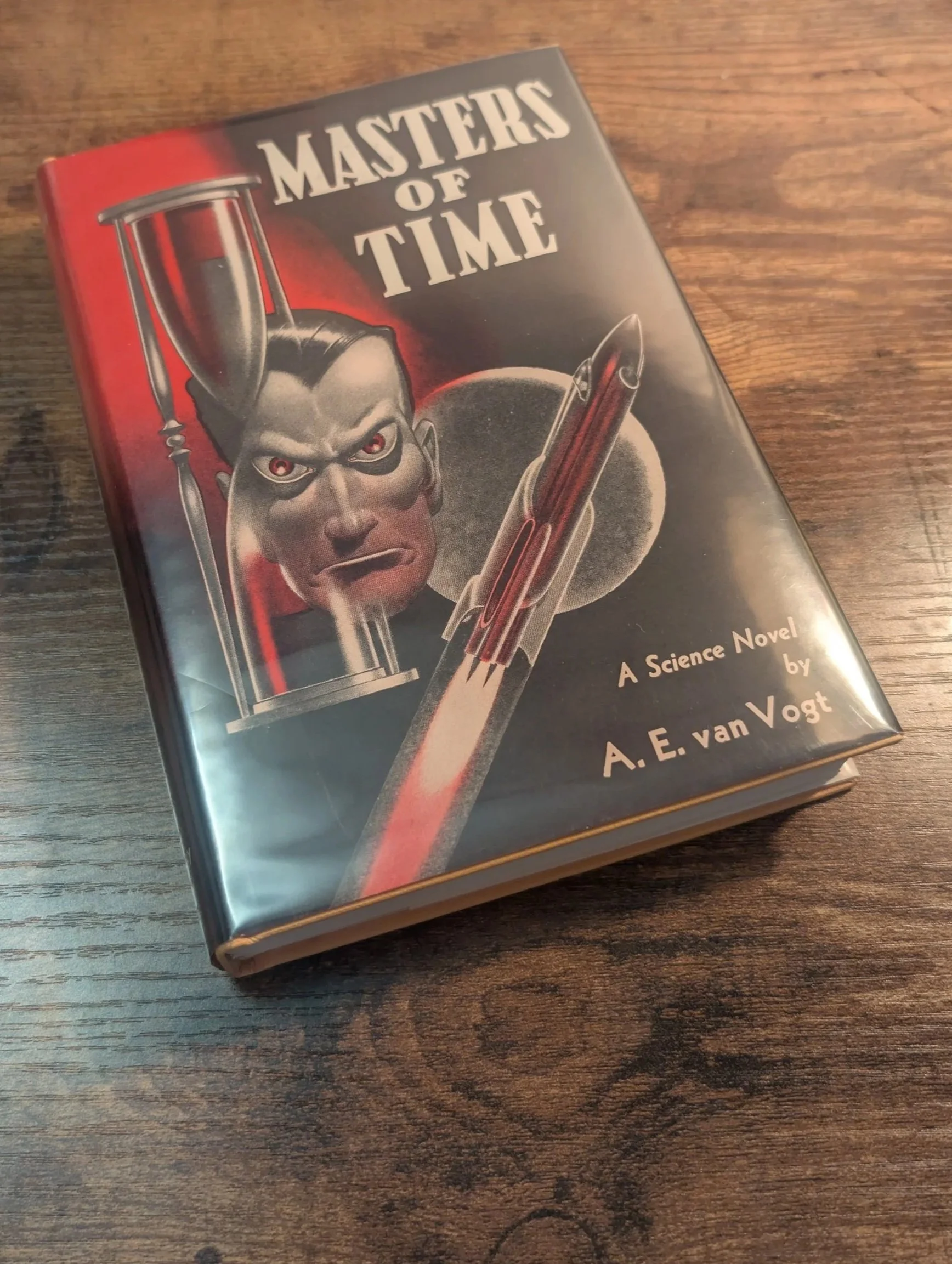
Masters of Time collects two of van Vogt's most celebrated novellas. The title novella — originally published in Astounding under the title "Recruiting Station" — is a time travel narrative operating at van Vogt's characteristic pitch: urgent, disorienting, and packed with ideas. The second novella, "The Changeling," is a more compact piece that showcases van Vogt's interest in identity and hidden potential. Both appear here in their first hardcover editions.
The Fantasy Press edition was illustrated by Edd Cartier, whose work for Unknown and Astounding made him one of the most beloved artists of the pulp era. His presence in a Fantasy Press volume is itself a mark of quality — Cartier's illustrations were sought-after, and his collaboration with Fantasy Press gave the hardcover editions a visual identity that matched their literary ambitions.
Identifying the First Edition
According to Currey's Science Fiction and Fantasy Authors, the Fantasy Press first edition of Masters of Time (1950) presents in three binding variants with a documented priority: dark red cloth with gold spine stamping is first priority; tan cloth with black spine stamping is second; blue cloth with black spine stamping is third. The first edition is so stated on the copyright page.
Two issues exist with no priority between them: a trade issue, and a limited issue of 500 copies with a numbered leaf signed by van Vogt inserted. The signed issue commands a significant premium when it surfaces.
Chalker and Owings' The Science-Fantasy Publishers adds a crucial layer to the binding picture. The dark red cloth issue accounts for 4,034 copies, of which 500 are the signed limited. The tan cloth variant — which Chalker and Owings identify as a Greenberg binding — represents only 30 copies, produced from Fantasy Press sheets sold to Martin Greenberg's Pick-A-Book discount operation and bound separately in cheaper stock. This makes the tan cloth rarer by the numbers than even the signed limited issue, though collectors should understand the distinction: scarcity here reflects the mechanics of a remainder operation, not a prestige printing decision.
One additional bibliographic note: the 1967 Macfadden paperback reprint drops "The Changeling" entirely, as does the 1960 Ace reprint issued as Earth's Last Fortress. Per Chalker and Owings, Masters of Time is the only edition to collect both novellas together. That's a meaningful point of difference for anyone assembling a complete van Vogt collection
The Copy Available Now
The copy currently available at The Quill and Parchment is a first edition, first printing in the tan cloth Greenberg binding — 1 of approximately 30 copies documented by Chalker and Owings — in Near Fine condition in a Very Good unclipped dust jacket. The binding is tight, corners sharp, pages clean. The jacket carries characteristic spine sunning well-documented in Fantasy Press copies from this period.
This is not the standard dark red cloth Fantasy Press first, and we're not presenting it as such. It is something rarer and more obscure: a fully documented binding variant from one of the stranger footnotes in specialty press history, in better condition than its origins would lead you to expect. Full condition details, photographs, and bibliographic documentation are in the listing on our Fantasy Press shelf.