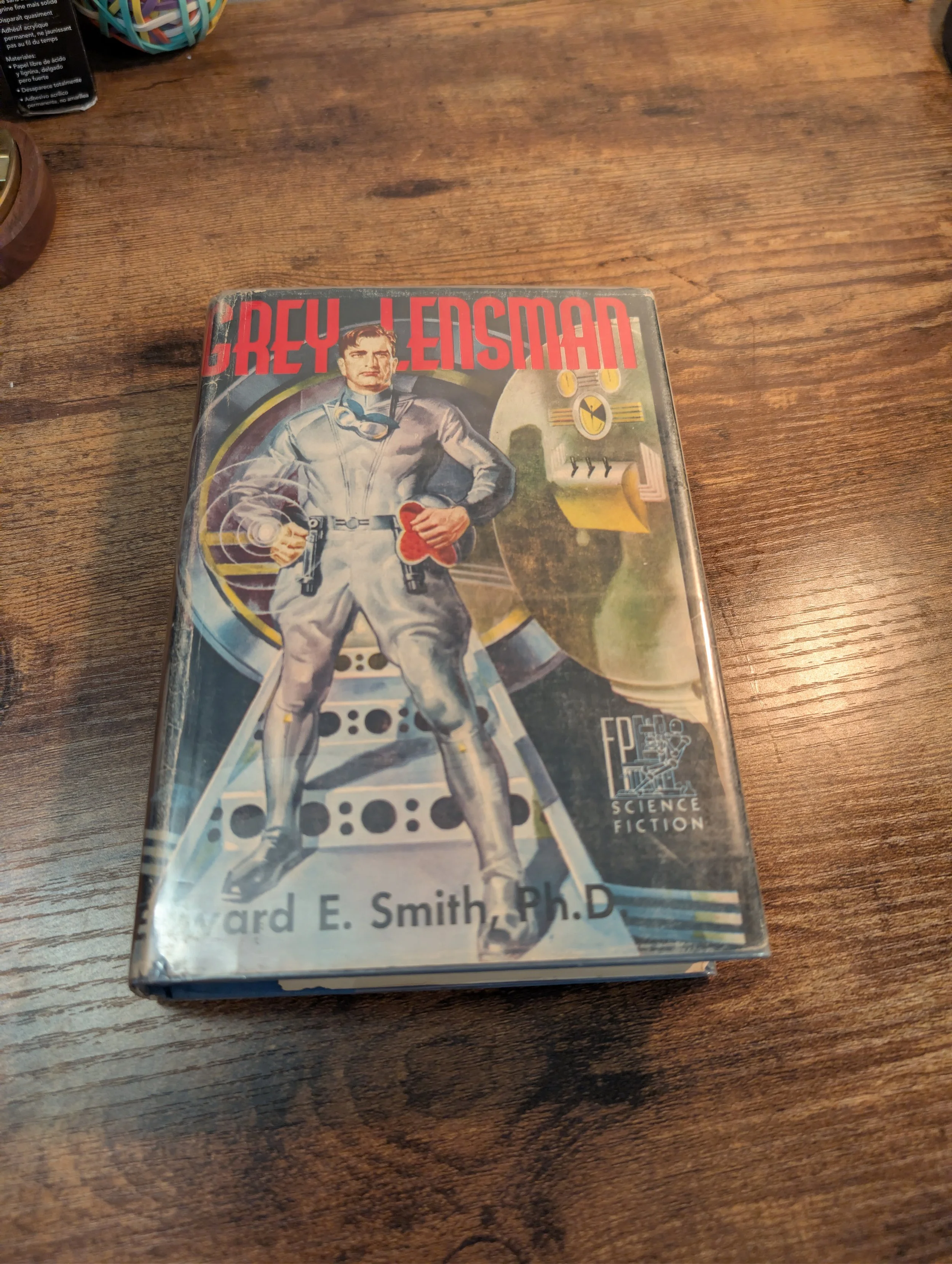
Gray Lensman is not a book that rewards casual attention. Published by Fantasy Press in 1951, it’s the fourth novel in E.E. “Doc” Smith’s Lensman series, and in the estimation of many who followed the genre through its formative years, the best of them. Chalker and Owings called it the high water mark of space opera. For a series that defined what space opera could be, that’s a meaningful distinction.
But before you can even begin to evaluate a copy, the book hands you a test.
The dust jacket spells the title “Grey Lensman.” Open to the title page, and it reads “Gray Lensman.” That discrepancy has tripped up sellers for decades, and it separates copies with a genuine collecting history from ones that don’t. The “Grey” spelling on the jacket is not an error to be explained away. It’s the identifying mark of the first state dust jacket, and its presence is one of two things you need to verify before representing a copy as a true first.
The second is the rear panel. Currey’s bibliography documents two jacket states: the priority jacket advertises three titles in Smith’s Lensman series on the rear panel; the later jacket advertises five titles by other Fantasy Press authors. A copy in the priority jacket will have both of these features:“Grey” on the cover and spine, three Lensman titles on the back. Miss either one, and you’re looking at a later state.

The binding adds a further layer. Currey records only one binding for Gray Lensman: dark blue boards with the spine lettered in gold. Chalker and Owings note a reported Greenberg variant in light blue boards with black lettering, but Currey is explicit that no copy in that variant has ever been observed by a bibliographer. It exists in the literature as a reported state only. Buyers who encounter a copy in that binding represented as a first-state equivalent should ask hard questions.

Smith himself is a figure worth understanding if you’re building any serious Fantasy Press run. He was a food chemist by profession - he held a doctorate and worked in the doughnut industry for much of his career - who wrote science fiction in his spare time and, in doing so, invented much of the vocabulary that later writers inherited without attribution. The Lensman series, which began in the pulps in the late 1930s, established the template for galactic civilization, the concept of an intergalactic police force operating across species lines, and a scale of conflict that subsequent space opera has never really left behind. When Star Wars arrived in 1977, critics who knew their SF history recognized the debts immediately. Smith had been there first, by forty years.
Gray Lensman was first serialized in Astounding Science Fiction in 1939–40, during the period when John W. Campbell was remaking the magazine into something that took the genre seriously. The Fantasy Press hardcover, published in 1951, was the book’s first appearance between boards and Fantasy Press, operating out of Reading, Pennsylvania under Lloyd Eshbach, was doing for Golden Age science fiction what the genre’s later critical establishment would spend decades arguing about: treating it as literature worth preserving in a permanent, collectible form.
The standard trade issue came with a limitation issue of 500 numbered and signed copies, a detail Currey confirms for this title; consistent with Fantasy Press’s practice across the Lensman series. The print run for the trade issue, per Chalker and Owings, was approximately 5,096 copies total.
A priority-jacket copy in the confirmed dark blue/gold binding is the one worth holding out for. A copy that also carries the signed limitation leaf belongs to a very short list of things in Fantasy Press collecting.