Robert Heinlein’s bibliography is one of the most rewarding in science fiction collecting. It’s also one of the most complicated. Over a career spanning more than four decades, Heinlein’s work appeared under at least five distinct publishers, each with its own identification conventions. A first edition of Stranger in a Strange Land looks nothing like a first edition of Rocket Ship Galileo, and a collector who knows the rules for one period can still be caught off guard by another.
This guide walks through each major phase of Heinlein’s publishing history and tells you what to look for. L.W. Currey’s Science Fiction and Fantasy Authors: A Bibliography of First Printings is the authoritative reference for the titles covered through 1977 and the source for the bibliographic details here unless we say otherwise. Where a point comes from dealer descriptions or from our own examination of a copy, we say so, because those are different kinds of evidence and you should know which one you’re relying on.
The Specialty Press Years: Fantasy Press, Shasta, and Gnome (1948–1959)
Before Heinlein became a Putnam author, his hardcover first editions came from the small specialty presses that served the science fiction community in the late 1940s and 1950s. These are among the most collectible Heinlein titles, and some of the most bibliographically involved. If you’re building a serious Heinlein collection, this is where the real work is.
Beyond This Horizon (Fantasy Press, 1948)
Heinlein’s first Fantasy Press title. Currey records two bindings, with priority, if any, not established: brick red cloth, and medium blue cloth, both with the spine lettered and ruled in gold. He notes the blue cloth only on copies of the trade issue and says it appears to be a primary binding. There are two issues with no priority between them: 500 copies with a numbered leaf signed by Heinlein inserted, and the trade issue. First edition so stated on the copyright page.
One jacket wrinkle worth knowing: a variant dust jacket printed in blue exists, and it is a later state, not a proof. Currey quotes publisher Lloyd Eshbach saying it was printed when the press ran out of wrappers at the end of the edition, with perhaps 100 produced. Don’t read the blue jacket as a sign of priority.
For more on the press, see our post Fantasy Press: From Pulp to Serious Sci-Fi and How Lloyd Eshbach Built Fantasy Press.
Assignment in Eternity (Fantasy Press, 1953)
A more complicated binding picture. Currey lists three bindings, priority as listed. The first is brick red cloth, spine stamped in gold including six bands, with HEINLEIN set in type 3mm high. Next come the Greenberg remainder bindings: green cloth, green boards, and dark blue boards, all lettered in black. Last is a Grant remainder in red cloth stamped in gold much like the first binding, except that HEINLEIN is set in type 2mm high.
That 3mm against 2mm difference is the whole test between the true first binding and the Grant remainder, and it’s visible in a decent spine photograph. Two issues, no priority: 500 signed and numbered copies, and the trade issue. First edition so stated on the copyright page.
The Man Who Sold the Moon (Shasta Publishers, 1950)
Boards with cloth shelf back. First edition so stated on the copyright page. Currey records no binding variants. A New American Library Signet paperback followed in 1951, and Currey notes it is abridged.
The Green Hills of Earth (Shasta Publishers, 1951)
Same formula: boards with cloth shelf back, first edition so stated.
Revolt in 2100 (Shasta Publishers, 1953)
Again boards with cloth shelf back, first edition so stated. The three Shasta Heinlein titles share one identification pattern, which makes them easier to verify than the Fantasy Press books. For the rest of the Shasta list, including Bester and Campbell, see our collector’s guide to Shasta Publishers first editions.
Sixth Column (Gnome Press, 1949)
First edition so stated on the copyright page. Currey notes no binding variants for this title. It was later reissued in paperback as The Day After Tomorrow, so confirm the Gnome Press imprint before you buy on the title alone.
For the full Gnome Press story, see The Legacy of the Gnome: A History of Gnome Press (1948–1962).
Methuselah’s Children (Gnome Press, 1958)
This is one of the harder Heinlein identifications. There is no statement of printing on the copyright page, so the binding and the jacket carry everything. Currey records five bindings, the last four later, in probable sequence: black boards with the spine printed in red (the first), then gray cloth, red boards, green boards, and red cloth (reported, not verified).
The jacket is where most copies get misdescribed. Currey records a first jacket with 35 titles on the rear panel, in two states. On the first, the last line of the rear panel reads “The Gnome Press Inc. 80 East 11th St., New York 3.” On the second, the street address and the “3” have been removed. A later jacket lists 32 titles with a P.O. Box address in Hicksville.
The practical point: the title count on the rear panel doesn’t separate the two 35-title states. Only the address line does. We’ve seen dealers offer a second-state jacket, correctly described, that still lists 35 titles, and a later Hicksville jacket described the same way. Read the address, not the count.
Currey adds that although rumors of a second printing persist, publisher Martin Greenberg stated there was a single printing of 7,500 copies. He also records which bindings have been observed with which jackets, so binding and jacket together tell you where a copy sits.
One more caution, and this one comes from dealer listings rather than Currey or any other primary reference, so treat it as something to check rather than a point of issue. An Aeonian Press reprint of 1976 turns up in black cloth with gilt stamping, and we’ve seen it listed as a “first edition first printing.” Currey’s first binding is black boards with the spine printed in red, not gilt.
The Menace from Earth (Gnome Press, 1959)
First edition so stated on the copyright page. Currey records no binding variants.
The Unpleasant Profession of Jonathan Hoag (Gnome Press, 1959)
First edition so stated on the copyright page. Reissued as 6 x H by Pyramid Books in 1961.
The Scribner Juveniles (1947–1958)
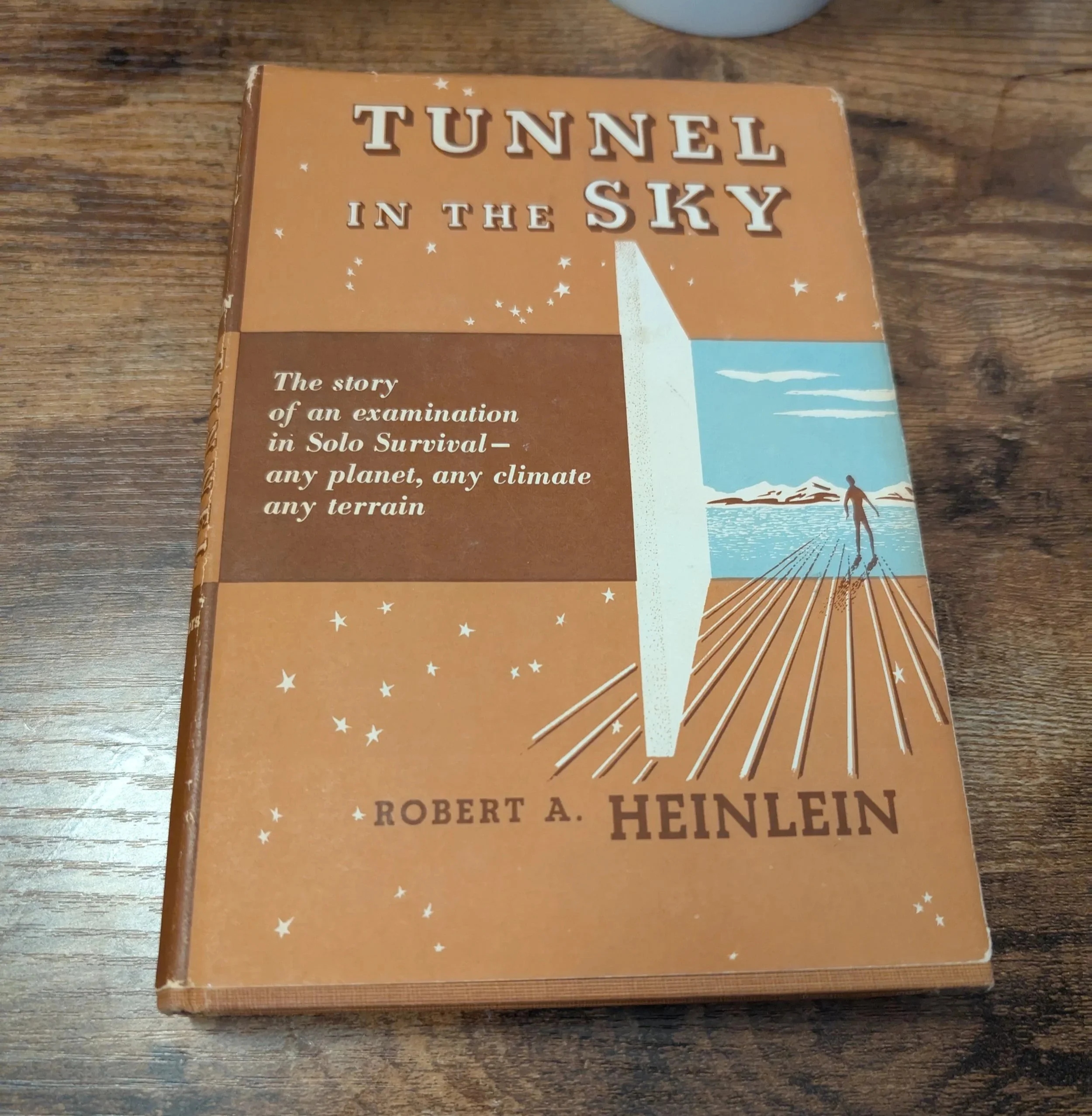
Twelve novels in twelve years, all from Scribner’s, all written for young readers, and all among the most enduring work Heinlein produced. For collectors, the good news is that Scribner’s used a consistent identification system across the run. The less good news is that these jackets were on children’s books, and they show it.
The copyright page
For most of the juveniles, a first printing carries the letter A on the copyright page. Currey gives it with the Scribner seal on most titles. The last three titles use a dated code instead of a plain A, and those codes are how Currey identifies the first printing.
The jacket
Currey records the first-printing jacket price for every title, and for several he records a later state where the printed price was clipped and a new price rubber-stamped in its place. That stamped jacket is a later state of the jacket. Jackets were applied to stock over time, so a first-printing book can turn up in a later-state jacket. A clipped corner with a stamp isn’t damage, it’s a state point, and it’s worth reading before you decide what a copy is.
Rocket Ship Galileo (1947): A and Scribner seal on the copyright page; first jacket $2.00. Later state: clipped, stamped $2.50 or $2.75.
Space Cadet (1948): A and Scribner seal on the copyright page; first jacket $2.50.
Red Planet (1949): A and Scribner seal on the copyright page; first jacket $2.50.
Farmer in the Sky (1950): A and Scribner seal on the copyright page; first jacket $2.50.
Between Planets (1951): A and Scribner seal on the copyright page; first jacket $2.50. Later state: clipped, stamped $2.75.
The Rolling Stones (1952): A and Scribner seal on the copyright page; first jacket $2.50. Later state: clipped, stamped $2.75.
Starman Jones (1953): A and Scribner seal on the copyright page; first jacket $2.50. Later state: clipped, stamped $2.75.
The Star Beast (1954): A and Scribner seal on the copyright page; first jacket $2.50. Later state: clipped, stamped $2.75 and $2.95.
Tunnel in the Sky (1955): A on the copyright page; first jacket $2.50. Later state: clipped, stamped $2.75.
Time for the Stars (1956): code A-8.56 [v] on the copyright page; first jacket $2.75.
Citizen of the Galaxy (1957): A and code 7.57v on the copyright page; first jacket $2.95.
Have Space Suit—Will Travel (1958): code A.9-58 [MJ] on the copyright page; first jacket $2.95.
Where no later state is listed, Currey records none. That doesn’t mean none exists.
Rocket Ship Galileo is the one to watch. Its first jacket is $2.00, and a $2.50 jacket, which would be correct on almost any other title in the run, is a later state on this one.
Condition on these books skews toward the worn end. They were read, re-read, lent out, and shelved without much care, and ex-library copies are common. Our guide to dust jacket grading covers how to read the wear.
The Doubleday Period (1950–1965)
Running alongside the juveniles, Heinlein wrote adult fiction for Doubleday: Waldo and Magic, Inc. (1950), The Puppet Masters (1951), Double Star (1956), and The Door Into Summer (1957), among others.
Identification here is clean. Currey records “First edition so stated on copyright page” for each of those titles. There are no binding sequences or jacket state hierarchies to work through, and because the test is a printed statement rather than the absence of one, a single clear photograph of the copyright page settles the edition.
The exception is Three by Heinlein (1965), a Doubleday omnibus of The Puppet Masters and Waldo and Magic, Inc. It carries no statement of printing and is a reprint. Currey records a code, G39, at the base of page 426.
The Putnam Years (1959–1973)
Starting with Starship Troopers in 1959, Heinlein moved his adult fiction to G.P. Putnam’s Sons and stayed into the 1970s. This period produced some of his most discussed work. The Putnam formula is the reverse of Scribner’s: Currey records no statement of printing on the copyright page for any of these titles, so the dust jacket price is the main tool.
Here are the first-printing jacket prices Currey records:
Starship Troopers (1959): $3.95
Stranger in a Strange Land (1961): $4.50 (see below; the jacket is only part of the story on this one)
Glory Road (1963): $3.95
Podkayne of Mars (1963): $3.50
Farnham’s Freehold (1964): $4.95
The Moon Is a Harsh Mistress (1966): $5.95
The Past Through Tomorrow (1967): $5.95 (a reprint collection of the Future History stories; see our post on Heinlein’s Future History)
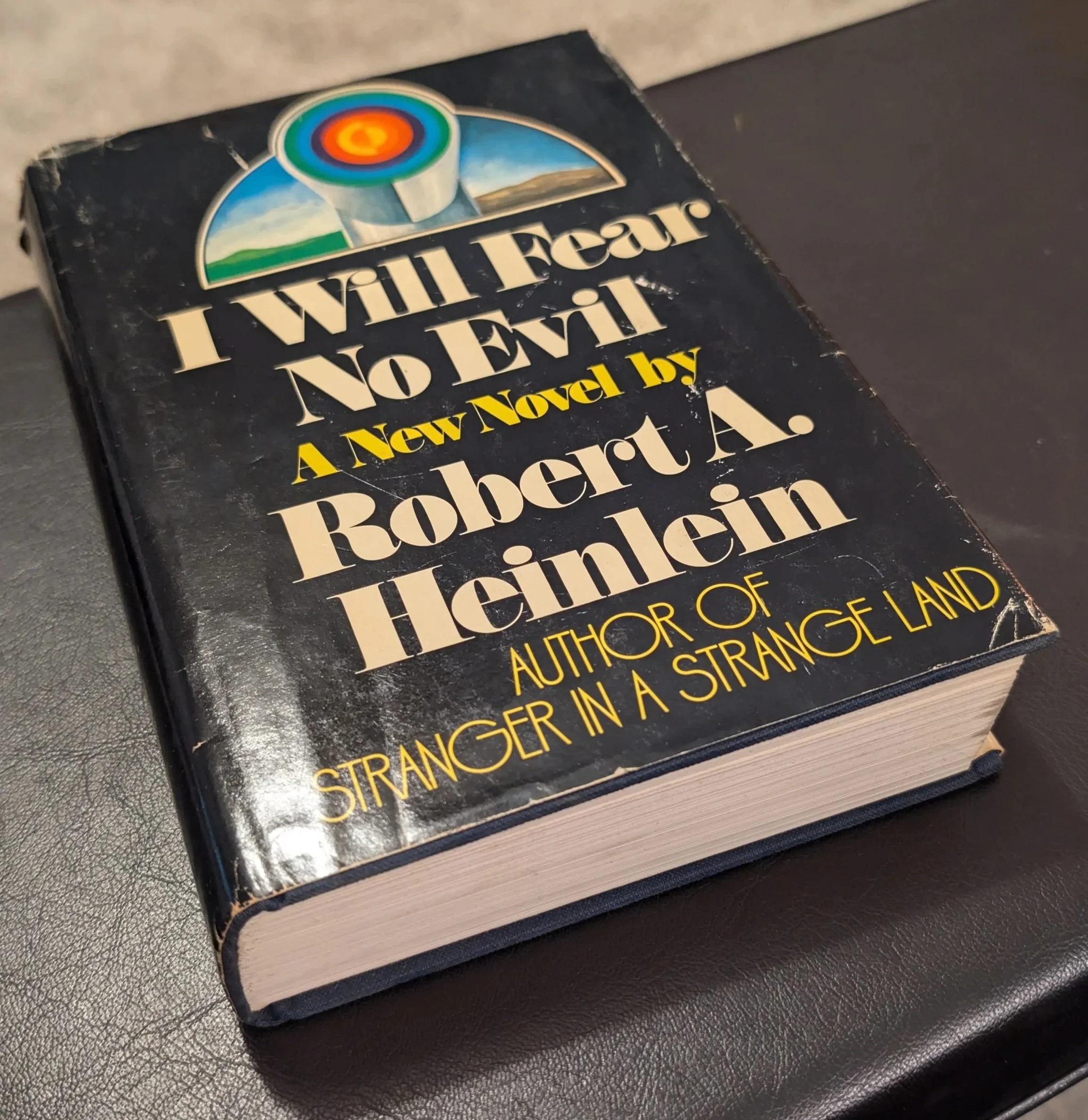
I Will Fear No Evil (1970): $6.95
Time Enough for Love (1973): $7.95
A jacket price identifies the jacket. It doesn’t identify the book inside it. Jackets move between copies, and Currey’s own introduction notes that the now common practice of marrying later-printing jackets to first-printing books wasn’t anticipated in the original edition of his bibliography. The marriage runs the other way too: a first-printing jacket can end up on a later book. On the Putnam titles, where the copyright page gives you nothing, that is the most likely way to be caught out. Where Currey records points in the book itself, as he does for Stranger, check them as well.
Stranger in a Strange Land (Putnam, 1961)
This is the hardest Putnam title to call, because the copyright page carries no statement of printing on the first, on later printings, or on the book club edition. Currey records code C22 on page 408, medium green cloth with the top edge stained light green, 28 books by Robert A. Heinlein listed on the verso of the half title leaf, and a jacket priced $4.50 at the top right corner of the front flap with Starship Troopers advertised on the rear panel. The book club edition carries C23 in the same spot, one character away.
Several different books get sold as the first of this title, and it has earned a post of its own: Four Books Called First Edition: Identifying the 1961 Stranger in a Strange Land.
The Later Titles (1980 and Beyond)
After the Putnam years, Heinlein’s novels came from several houses: Friday (1982) from Holt, Rinehart and Winston; Job: A Comedy of Justice (1984) from Del Rey/Ballantine; and The Cat Who Walks Through Walls (1985) and To Sail Beyond the Sunset (1987) from Putnam. These fall outside Currey’s coverage, which ends with 1977, so verify identification points against the books themselves.
Friday (Holt, Rinehart and Winston, 1982)
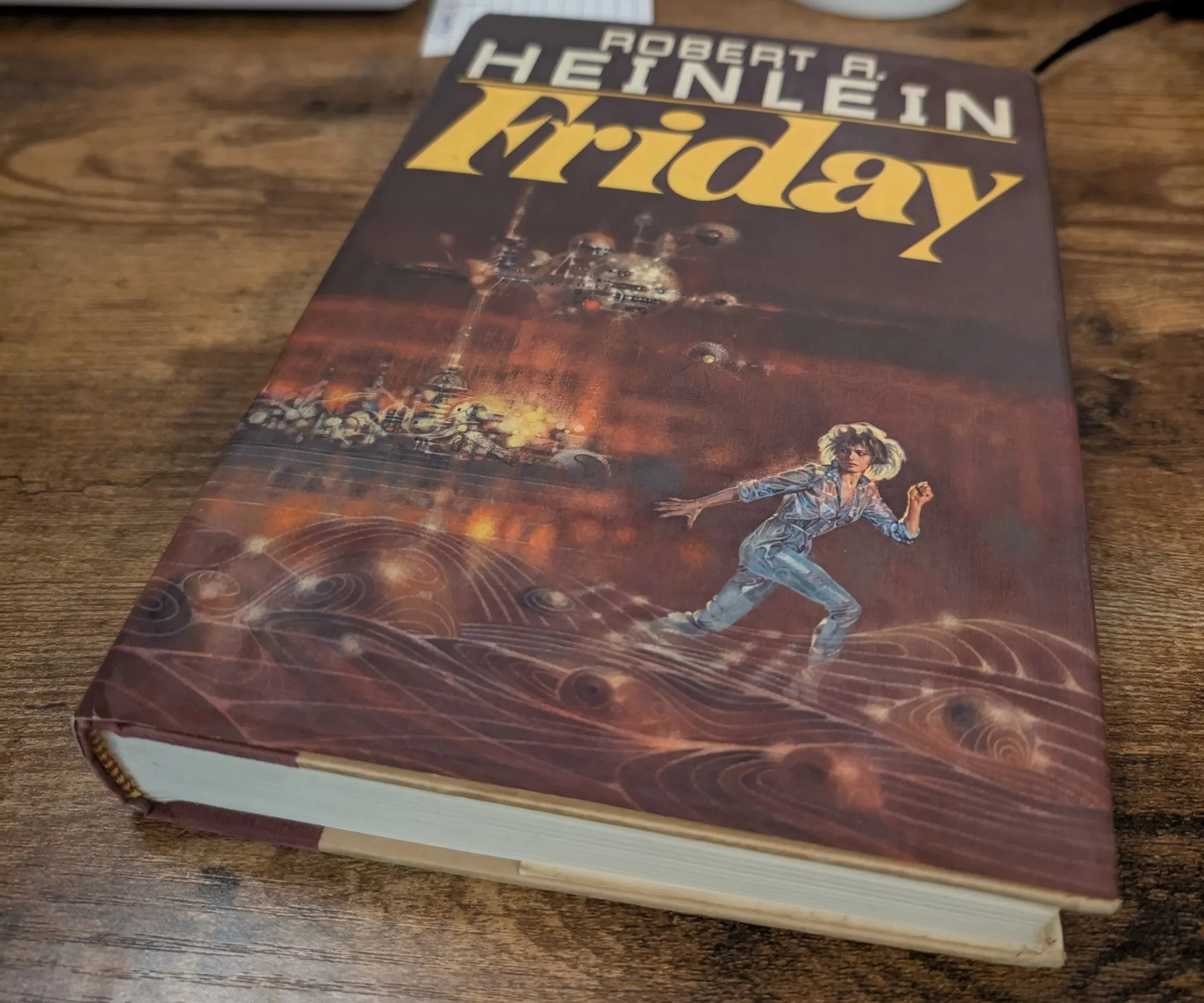
The copyright page states “First Edition” and carries a full number line, 10 9 8 7 6 5 4 3 2 1. That complete sequence is your primary identifier; a later printing drops the lowest numbers. The dust jacket is priced $14.95 on the front flap. The binding is quarterbound in maroon cloth and tan boards with gilt lettering on the spine, and the jacket art is by Richard M. Powers, whose work will interest collectors who follow SF cover artists.
A Note on Condition
On most Heinlein titles the dust jacket drives value, and a jacketless Scribner juvenile brings a fraction of what a jacketed copy does. Don’t take that as a universal rule, though. On Stranger in a Strange Land, the market prices the printing ahead of the jacket: dealers offer jacketless C22 firsts well above jacketed later printings. Jacket dependence varies by title, so judge each book on its own points.
The specialty press titles add binding condition to the calculation. Original cloth or boards in presentable condition, with an intact jacket, is the target. Worn bindings and missing jackets are common at the prices where most of these titles trade.
You can browse our current science fiction first editions in the science fiction section of the store.