Reading the Wrapper: A Collector's Guide to Dust Jacket Grading
On the surface, it may seem to be the least important part of the book - a paper wrapper meant to protect what’s inside. But to rare book collectors, the dust jacket (or dust wrapper, to our friends in the U.K.) is often the most important, and valuable, part of the package.
This guide covers the grading standards used across the SF collecting community, the specific defects that matter most to condition and value, and a few things worth knowing about the jackets produced by the mid-century specialty presses (Gnome Press, Fantasy Press) that show up most often in serious Golden Age collections.
Why the Jacket Matters
For most Golden Age science fiction first editions, the dust jacket isn’t optional—it’s essential. A copy of the Gnome Press Foundation without its jacket is still a first edition, and it’s still historically significant. It’s also worth roughly a fraction of what a jacketed copy commands. The rule of thumb that a first without a jacket is worth ten to twenty percent of a jacketed copy in comparable condition holds broadly across the specialty press market, and in some cases the spread is wider. The jacket is where the money lives.
That isn’t arbitrary. Dust jackets were produced in small quantities, printed on fragile paper, and almost universally discarded by libraries, casual readers, and previous owners who didn’t think of them as part of the book. Seventy-five years of survival has done further work. An intact jacket in collectible condition represents something genuinely scarce, and the market prices it accordingly.
Jacket condition also has an outsized effect on a book’s visual appeal, which matters for display-grade copies and gift purchases alike. A Near Fine book in a Very Good jacket reads differently on a shelf than the same book in a Good jacket. Collectors who care about presentation know the difference immediately.
The Grading Scale
The SF collecting community uses a shorthand grading scale that runs from Fine down through Poor. When a book is listed with two grades—VG/VG, NF/VG+, and so on—the first refers to the book and the second to the jacket. Most of the meaningful distinctions happen in the Fine-to-Very Good range, which is where the majority of buying decisions get made.
Fine (F) — As close to new as a book that has existed for decades can reasonably be. No fading, no wear, no soiling. For a jacket, this means sharp corners and tips, no closed or open tears, bright color across the spine and panels, and no price clipping. Fine jackets on Golden Age SF are rare enough that the grade should be applied sparingly. A claim of “fine” also warrants careful inspection to be sure that grade truly stands.
Near Fine (NF) — Very close to Fine, with only the most minor signs of age or handling. A small bump to one corner tip, the faintest hint of shelf wear at the spine ends, or very light toning to the flaps. Nothing that registers at arm’s length. NF is a practical ceiling for most vintage jackets in honest condition.
Very Good Plus (VG+) — Shows light wear that falls just short of Near Fine. A small closed tear, a modest bump to a corner, some light rubbing at the spine ends. The jacket still presents well and would satisfy most collectors. For Golden Age SF, VG+ is a realistic and desirable grade.
Very Good (VG) — Shows obvious but not severe wear. Small closed tears, rubbing to the spine ends, light soiling, minor edge wear. The jacket retains its overall integrity and pictorial quality. VG is a perfectly respectable grade for a 70-year-old SF jacket and represents the bottom of the range that most serious collectors will pursue for display copies.
Good (G) — Significant wear throughout. The jacket is present and identifiable but shows heavy edge wear, soiling, fading, closed and possibly open tears, or other damage that meaningfully affects appearance. Good is primarily a reading or holding copy grade. Some collectors will accept Good on extremely scarce jackets where the alternative is no jacket at all.
Fair and Poor — The jacket is severely damaged, incomplete, or present only in fragments. These grades are almost never relevant for a collector’s copy, though a badly worn jacket may still serve as a placeholder while a better one is sought.
Clipped and Unclipped
One of the most consistent factors affecting jacket desirability is whether the price has been clipped from the front flap. Clipping was standard practice for decades—gift givers removed prices as a courtesy, and librarians clipped them as a matter of policy. On a jacket issued with a printed price on the front flap, an unclipped copy is always preferable.
The practical effect on value varies by title and period, but for Golden Age SF first editions, an unclipped jacket can represent a meaningful premium over a clipped one in otherwise identical condition. For identification purposes, the price on the front flap can also serve as confirmatory evidence for first printing status; something to keep in mind when evaluating points of issue.
A related practice worth knowing: some jackets have had their clipped margins trimmed further to create a cleaner edge, what’s sometimes called price restoration. The result can look deceptively tidy. If the flap edge appears unusually sharp and uniform, or if the flap is measurably shorter than the other, it’s worth a closer look.
Common Jacket Defects
The vocabulary sellers use to describe jacket condition can vary, but the defects themselves are consistent. Here are the ones that appear most often in Golden Age SF listings, and what they actually mean.
Spine fading or sunning. The jacket spine is the most exposed part of the book when it’s shelved, and prolonged light exposure bleaches the color from the spine panel. Mild sunning reads as slight color lightening; heavy sunning can fade a spine to near-white. Once faded, a spine cannot be restored without restoration work that most serious collectors consider a further detriment. Spine sunning is probably the single most common defect in vintage SF jackets.
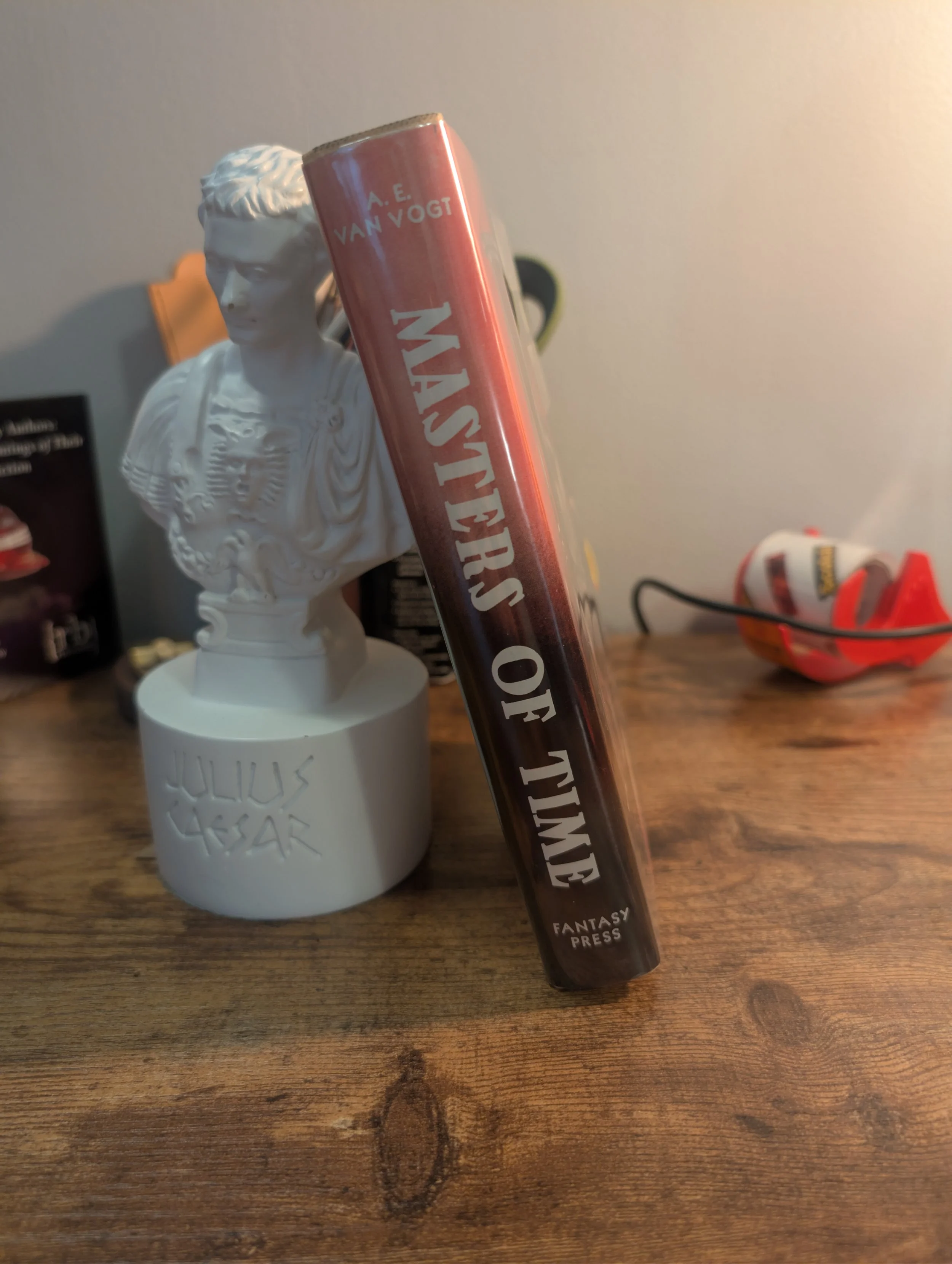
This copy of Masters of Time shows light fading to the spine, a typically observed trait of Fantasy Press Titles
Chipping. Small losses of paper at the jacket edges, corners, or spine ends. Chips are distinguished from tears by the absence of paper—the material is gone rather than torn. A chip at the crown of the spine is among the most common single defects on vintage SF jackets. Minor chipping is often acceptable in otherwise high-grade copies; extensive chipping significantly affects grade.
Closed tear. A tear in the jacket where the paper has separated but no material is missing. The tear is present but the edges align. Closed tears are considerably less severe than open tears and, on an otherwise strong jacket, may represent only a modest grade reduction.
Open tear. A tear where the paper has separated and the edges no longer align cleanly, or where a flap or panel has partially detached. Open tears are more significant than closed tears and, depending on location and size, can have a substantial effect on grade and desirability.
Rubbing and edge wear. General friction wear at the corners, spine ends, and edges from handling and shelving. Light rubbing is common on vintage jackets and expected at Very Good. Heavy rubbing affects color and surface integrity and moves a jacket into Good territory.
Soiling. Surface dirt, fingerprints, stains, or other marks on the jacket panels or flaps. Light soiling at the flaps is common and often acceptable; soiling to the front or rear panel, or staining of any kind, is a more significant defect.
Previous owner inscriptions. Names, dates, or notations written on the jacket—usually on the inside of a flap. These affect the collectibility of the copy but don’t necessarily disqualify it, particularly if the inscription is small and unobtrusive. Significant writing or stamps on the exterior of the jacket are more problematic.
Taping and repairs. Tape applied to tears or weak areas—including so-called “book tape”—is generally regarded as a net negative in the collector market, even when the repair is tidy. Yellowed or brittle tape is a more serious problem. Professional restoration work is a separate category and should be disclosed by the seller; undisclosed restoration is a significant red flag.
Publisher-Specific Observations: Gnome Press and Fantasy Press
Collectors who focus on the mid-century specialty presses encounter a handful of defect patterns that turn up consistently enough to be worth knowing in advance. The following observations are based on firsthand handling of these books rather than published bibliographic sources, so they should be treated as pattern recognition rather than authoritative documentation.
Gnome Press. Gnome jackets are particularly prone to crinkling and chipping at the head and foot of the spine. Because Gnome often used slightly oversized jackets relative to the boards they covered, the excess paper at the spine ends has a tendency to crinkle over time. Spine fading is also common. When evaluating Gnome Press jackets, pay close attention to the spine ends and expect some degree of wear there even on otherwise strong copies.
Fantasy Press. Fantasy Press is known for high production quality—gilt stamping, cloth boards, limited print runs—but the jackets are fragile. Spine sunning is the most common defect, and it can be pronounced even on copies that have otherwise been well cared for. The fading appears to owe to the paper and inks used in the early 1950s production runs. A Fantasy Press jacket with a bright, unfaded spine is a genuine find; moderate spine sunning on an otherwise sound jacket is the norm rather than the exception.
Neither of these observations should discourage a purchase—they’re predictable characteristics that any experienced collector of these presses has learned to account for. They should inform how you grade a copy and how you weigh condition against price.
Protecting What You Have
Once you have a jacket worth protecting, protect it. Archival-quality polypropylene or Mylar sleeves—commonly called Brodart sleeves after the most widely used brand—are the standard solution. They’re inert, clear, and fitted to the book, which means the jacket is shielded from handling, humidity fluctuation, and further edge wear without being removed from the book it belongs to. Any serious collector handling vintage jackets regularly should consider them non-optional.
At The Quill and Parchment, every jacketed copy we ship goes out sleeved in a Brodart protector. It’s a small thing, but for a 70-year-old jacket that’s already survived this long, the additional handling protection during shipping isn’t trivial.
Storage matters too. Light is the enemy of jacket color—the same spine fading that makes a Fantasy Press jacket a challenge to find in good condition is still happening, slowly, on shelves exposed to UV. If long-term preservation is a priority, UV-filtering sleeves are available and worth the added cost for significant copies.