First Published in Hardcover: The Line That Is Not a First Edition
Larry Niven’s Ringworld offers a challenge for SF book collectors: the 1977 Holt, Rinehart and Winston printing’s copyright page reads like good news. It says the book was first published in hardcover in 1977 and includes the tell-tale numberline, 1-10, usually indicating a first edition, or at least a first printing. Two pieces of evidence agreeing with each other, and a seller can type first edition into a listing without feeling they cut a corner anywhere.
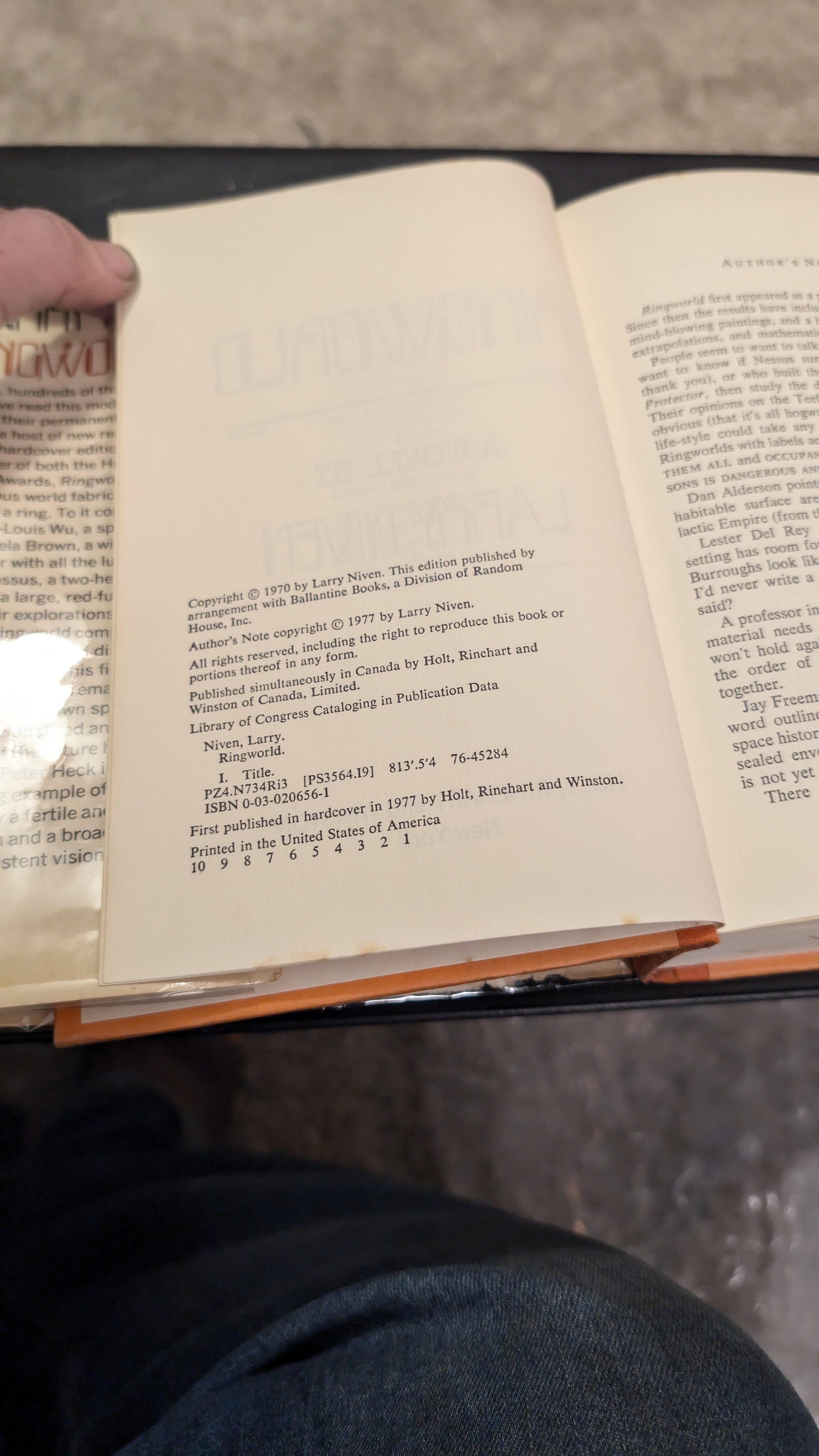
A confusing copyright page that makes this printing appear like a first. But, according to Currey, it isn’t.
But it’s not a first edition. Ringworld had been in print for seven years by the time that copy was bound, and the copyright page is telling the truth about a question nobody asked.
What Currey actually records
Currey's Science Fiction and Fantasy Authors gives Ringworld three entries, and the sequence of them is the whole argument.
The first is New York: Ballantine Books, [1970], in wrappers, with First Printing: October, 1970 on the copyright page, issued as Ballantine Books Science Fiction 02046-4-095 at 95 cents. That paperback is the first edition. Nothing in cloth came out beside it.
The second is London: Victor Gollancz Ltd, 1972, boards, no statement of printing on the copyright page. Currey calls that the first hardcover edition. If you want Ringworld in cloth and you want it first, the Gollancz is the book.
The third is the Holt, boards with a cloth shelf back, and Currey records both the hardcover statement and the number line. It also notes that the Holt adds an Author's Note, which makes it a textually distinct printing even while it stands third in line. That is a real reason to own one. It is not a reason to call it a first.
The statement is true, which is exactly what makes it work
“First published in hardcover in 1977” is a claim about format. It tells you when the book first appeared in boards in the U.S., says nothing about when the book first appeared, and is built so that a reader supplies the missing half of the sentence without noticing they did it.
Read strictly it does not hold up even as a format claim. Gollancz had the book in boards in 1972. Without the words in the United States, the sentence as printed runs against what Currey records, and that is a conflict between a publisher and the bibliography rather than a fine distinction.
The number line does not rescue it either. A number line ending in 1 tells you the copy is the first printing of the edition it is bound into. The 1977 Holt is the first printing of the 1977 Holt. Both statements can sit on the page together, and neither one reaches back to 1970.
The same sentence, in other people's books
Once you have seen the shape of it, it turns up all over the shelf.
Niven's own list repeats it four more times. World of Ptavvs is Ballantine, 1966, wrappers, First Edition: August, 1966 on the copyright page, and the first hardcover is Macdonald in 1968 reading First published in Great Britain in 1968. A Gift from Earth runs Ballantine 1968 in wrappers, then Macdonald in 1969. Neutron Star runs Ballantine 1968, then Macdonald 1969. Protector is Ballantine 1973 in wrappers, and the Compton Russell hardcover of 1976 opens with This hardcover edition first published in Great Britain in 1976.
Robert Silverberg's Night Wings is an Avon paperback of 1969, First Avon Printing, September, 1969 on the copyright page. The Walker hardcover of 1970 says First published in book form in the United States of America in 1970, which is a more confident sentence than the Holt's and covers more ground while narrowing the claim just as far.
M. John Harrison's The Pastel City is the sharpest version of all of them. New English Library published it in wrappers in 1971, First NEL paperback edition 1971 on the copyright page. The Doubleday hardcover of 1972 carries First edition in the United States of America, and Currey records that one as the first hardcover edition. There the words first edition appear with no hedging at all. The qualifier doing the work is four words long and sits at the end of the line, where a reader in a hurry will drop it.
Fahrenheit 451, and why this is a habit rather than an accident
Currey has Fahrenheit 451 as New York: Ballantine Books, Inc., [1953], in four bindings, with no sequence determined for the hardcover copies but all of them preceded by those in wrappers. The wrappers are Ballantine Books 41 at 35 cents. The hardcovers are a red cloth lettered in gold, which Bradbury said was about fifty copies bound for his own use, a red boards binding lettered in yellow, and the Johns-Manville Quinterra asbestos binding, 200 numbered copies signed by the author and issued without a jacket.
So here the hardcovers are not later editions, one of them is the most sought object on the entry, and the paperback still comes first.. The 1967 Simon and Schuster printing then says First printing so stated, fourteen years after the fact, with a new Bradbury introduction to justify itself.
Where the bibliography stops
Two limits on all of this. Currey's revised edition covers first printings through the end of 1977, so anything later, including the rest of the Ringworld sequence, is outside it and needs a different reference. And the entries are built around trade publishers rather than book clubs, though club printings do surface in them: Silverberg's Downward to the Earth is recorded as Nelson Doubleday, 1970, no statement of printing, in four printings separated by codes 28L, 39L, 50M and 24N at the base of page 179.
If a hardcover has no price on the jacket flap and no printing statement worth the name, the code at the back of the text block is usually the thing that settles it, which is the same test that sorts the Dune book club printings.
First edition thus, which is the label that actually fits
None of this means the Holt is nothing. It is the first appearance of that Author's Note, under a new publisher and in a format the book had not had in America before, and the trade has a term for exactly that situation: first edition thus. A dealer who writes first edition thus, adding the Author's Note not present in the 1970 Ballantine or the 1972 Gollancz, has described the book accurately and told a buyer something worth knowing.
The Simon and Schuster Fahrenheit 451 of 1967 is the same case. First printing so stated on the copyright page, a text following the 1953 Ballantine, and a new introduction by Bradbury. Not a first edition. A first edition thus, and the new introduction is the reason.
The term earns its keep when the new element is named alongside it. Left bare it drifts, since nothing in the phrase says how much new matter is required, and it gets stretched over reissues carrying nothing newer than a cover. Currey does not use it at all, which is worth remembering before treating it as a bibliographic category rather than a way of describing a copy honestly.
What to do with a hardcover that claims a first
Read the exact words before anything else, because the qualifier is the whole message. In hardcover, in Great Britain, in the United States, in book form: each of those narrows the claim to a point where it stops answering the question a collector is actually asking, and none of them is a lie.
Then look at the author entry rather than the title line, since the trap lives in the sequence. An ALSO entry above the one you are reading means an earlier edition exists, and on a science fiction title from the 1950s through the 1970s there is a fair chance it is in wrappers. Treat the number line as a test of printing within an edition and nothing more. A copy can be the first printing of the third edition, which is what the Holt is, and that phrase is worth putting in a listing exactly that way.
So the honest listing for the Holt is not a shorter one, it is a more specific one: first printing of the first American hardcover edition, first edition thus, adding the Author's Note. That takes nothing away from the book and it keeps the seller out of the argument entirely. The trouble only starts when a copyright page gets read as a verdict instead of a sentence. More cases of that in when first edition is not a first edition, and the rest of what is on the shelf is in the science fiction catalog.