In 1952 Philip José Farmer went to Chicago to collect a prize. He had entered a contest for the best science fiction novel of the year, run by Shasta Publishers with Pocket Books behind it, and he had won it outright. There were photographs. There was publicity. And at the end of it he was handed a check that was blank and unsigned.
That is where the Riverworld books come from. Not from the 1971 novel most collectors know, but from a manuscript that was never published, never returned, and is now almost certainly gone. The book that survived the wreck is River of Eternity, published by Phantasia Press in 1983. It is worth understanding what it actually is, partly because the story is remarkable and partly because the bibliographic record of it is a genuine mess, in a way that neither the standard reference nor Farmer himself can fully clean up.
What happened at the contest
The fullest account is in Chalker and Owings, The Science-Fantasy Publishers, in their Shasta entry on page 395, and they take it from Farmer himself.
Erle Melvin Korshak of Shasta announced that he had an agreement with Pocket Books to run a contest for the best science fiction novel of the year, Shasta doing the hardcover and Pocket the paperback, for a considerable sum. Farmer decided late in the game to submit an entry; he wrote diligently for many hours a day and finished a massive novel on the final day of the contest. The story was one in which everyone who ever lived on Earth wakes on the banks of a monstrous river on an alien world. It won easily; Farmer was justifiably elated.
Then came the ceremony and the blank check. When Farmer asked, Korshak, with apparent surprise, said he was sure he had mentioned that Pocket wanted changes and cuts before it would pay. Farmer went home to Peoria, Illinois with nothing.
What he learned later is the part that gives the story its edge. Pocket had paid the full amount up front, before the contest was ever announced. Korshak, running Shasta badly short of cash by 1952, had put the money into the company against back bills and printing bills, expecting to earn it back before he had to produce it. He never did. The novel was never published and the manuscript did not come back.
Nobody is sure what it was called
Here is where a collector expects the reference to answer the question and it does not.
Chalker and Owings gives the contest novel as I Owe for the Flesh (pg.395). In the entry for River of Eternity itself, the same reference gives the original as Owe for a River, "announced at one point by Shasta as I Owe For the Flesh," (pg. 341). Then page 395 turns around and describes Owe for a River as a separate incarnation, also lost. Those two entries cannot both be right. One makes the titles two names for a single book. The other makes them different drafts.
The natural move is to go to the author, and Farmer's introduction answers half the question cleanly. He names the third version without qualification: "It seemed to me that the third version, Owe for a River, was an improvement over the other two." That settles the page 341 problem. Owe for a River is a distinct version, not another name for the contest novel, which is what page 395 says and what page 341 gets wrong.
On the contest manuscript itself he is markedly less certain: "The original novel, which I think I titled Owe for the Flesh."
That hedge is the most useful phrase in the whole tangle, and the contrast with the sentence above it is what gives it weight. Farmer is not a vague writer here. He names the third version flatly because he had it in front of him. He qualifies the first because he wrote it at speed in 1952, never got it back, and was reaching for its title three decades later with nothing to check against. He is not asserting that title. He is remembering it.
So part of the record closes and part of it does not. Page 341 is wrong to attach Owe for a River to the contest manuscript, and both Farmer and page 395 say so. But the contest novel's own title is not recoverable. It was something close to Owe for the Flesh, which is what Farmer remembers and, allowing for the added "I," what Shasta announced it under. Past that the trail runs out, and anyone who tells you the matter is settled is guessing.
None of this is a knock on a reference we use constantly. Chalker and Owings is the authority for the specialty publishers and nothing replaces it. But bibliography is not scripture, and this is a case where the record is uncertain at the source. The honest description says so rather than picking whichever version reads better.
What River of Eternity actually is
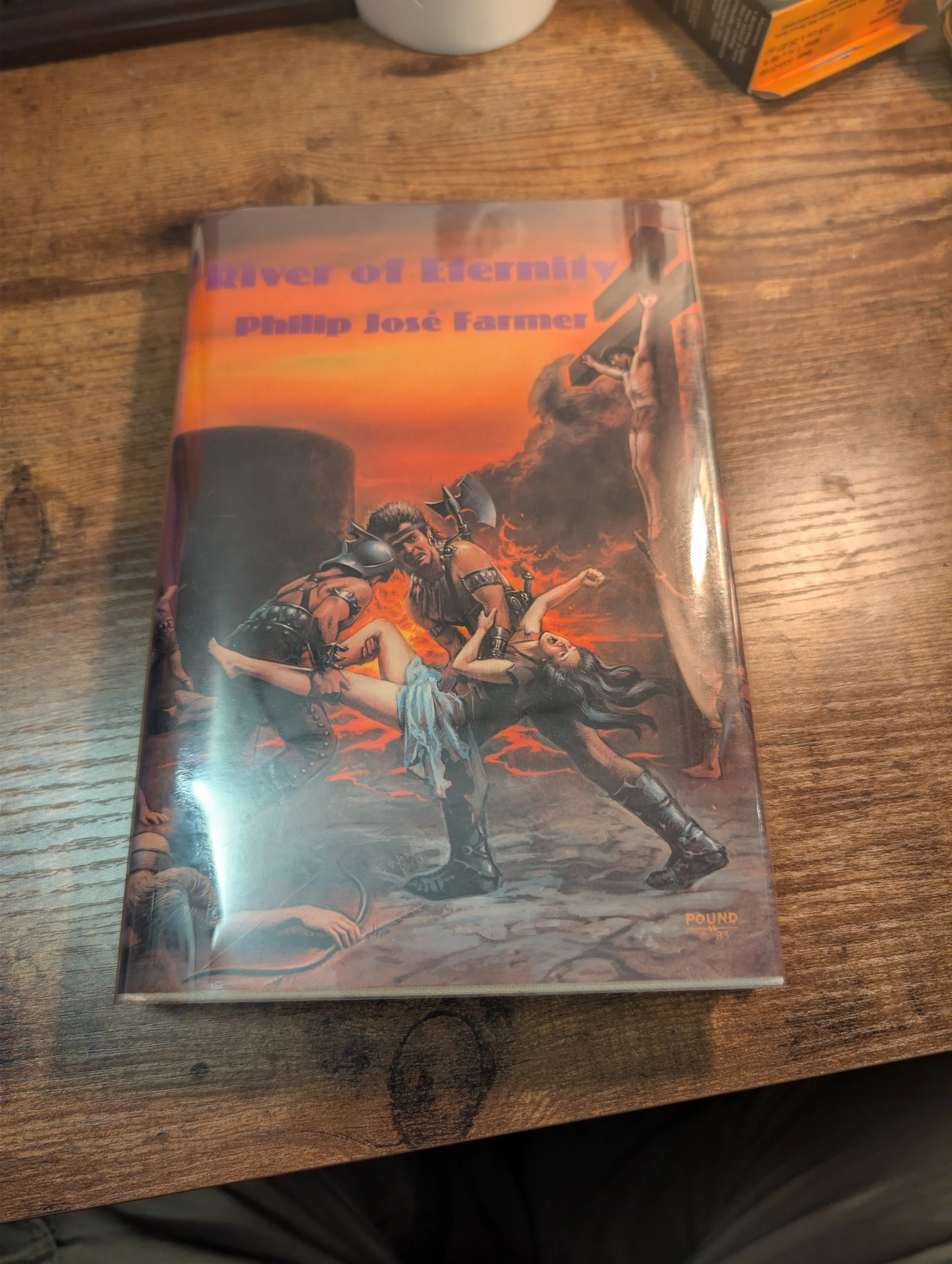
Farmer's introduction and Chalker and Owings agree that River of Eternity is the second version of the contest novel, and Chalker and Owings adds that he wrote it from the original as a desperate attempt to get the thing published. It failed at the time. It did not reach print until 1983, long after the rewritten Riverworld saga had gone on to fame and glory.
Farmer states in the introduction that the first version is likely lost forever, and that he was able to see the second and third. He goes on to describe a fourth, which makes four in all and matches the count in Chalker and Owings, arrived at independently. Chalker and Owings records that the endings of the known variations differ radically from one another, and is blunt that the published series is quite different from what it came out of.
There is a wrinkle here that collectors will enjoy. Farmer read all the surviving versions and preferred a different one: "It seemed to me that the third version, Owe for a River, was an improvement over the other two." The text Phantasia published in 1983 is the second version, not the one its author rated highest. Chalker and Owings describes Owe for a River as lost, though Farmer plainly had it in hand long enough to judge it. Whether it survives anywhere now is not something either source settles, and it means the version Farmer liked best is the one nobody has ever been able to read.
That is the collecting argument for this book, and it is worth being precise about. River of Eternity is not a curiosity edition of a novel you already own. It is a different book, written by an author working the same idea before it had been shaped into a series. Chalker and Owings heads its entry "Only publication anywhere," which in that reference means what it says: the 1983 Phantasia book is the only edition of this text ever issued, with no reprint, no paperback, and no edition outside the United States. The first and third versions were never printed in any form. Until 1983 there was no way to read the early Riverworld at all.
How the surviving manuscript resurfaced is less clear than the rest. Chalker and Owings describes a carbon auctioned at a science fiction convention, bought by a California fan who knew Farmer was hunting earlier versions. Farmer's introduction does not describe the recovery at all. We report both and claim neither.
How the fourth version became the Riverworld books
Farmer's introduction accounts for the rest, and it explains why the series looks the way it does.
Owe for a River, the third version, went to Ballantine, which turned it down as "more adventure than anything else." Farmer then sent it to Frederik Pohl, who was editing Galaxy, Worlds of If and Worlds of Tomorrow. Pohl returned the manuscript with a note that ended up shaping every Riverworld book since. The novel was very long and still too compressed. The concept was too big to do justice to in one novel, or even two and perhaps three. Why not rewrite it as a series of novelets for one of his magazines, which would give the Riverworld room to develop?
Farmer's answer, in his own words: "O.K. Splendid idea." That rewrite is the fourth version.
Two Burton novelets and two Clemens novelets out of it became the basis for the Putnam editions of To Your Scattered Bodies Go and The Fabulous Riverboat. So the series collectors know does not descend from the contest manuscript directly. It descends from a fourth rewrite, undertaken on an editor's suggestion, of a book that had already been rejected twice after being stolen once.
Identifying the 1983 Phantasia Press issues
The book was published in two issues, and the difference is worth knowing before you buy one.
Chalker and Owings records 500 copies in a special binding with a matching slipcase, signed and numbered by Farmer, at $40.00, and a 2,500 copy trade edition in white cloth over boards at $17.00. The book itself carries limitation statements for both. The trade statement reads that the first edition "is limited to 3,000 copies. The first 500 copies have been signed and numbered by the author." The signed copies carry their own leaf describing a specially bound edition of 500, signed and numbered.
Three practical points follow.
The dust jacket will not tell you which issue you have. It was printed for both and priced for both, reading "Trade edition: $17/Special edition: $40." Jacket photographs alone settle nothing.
A signature does not tell you either. Farmer signed trade copies as well, and copies signed by him with no limitation leaf come up for sale described simply as signed first editions. That is a real thing and worth owning. It is not the special edition.
The limitation leaf and the binding are what settle it. A copy in white cloth over boards with no slipcase is the trade issue no matter how the listing is worded. The special issue is separately bound, and its slipcase is covered to match the binding.
One further note for anyone building the Riverworld books proper. Currey's revised edition covers first printings through the end of 1977, so it does not reach the 1983 Phantasia book at all, and Chalker and Owings is the reference to use for that one. Currey does cover the two Putnam novels that came out of the fourth version, and records that To Your Scattered Bodies Go (G. P. Putnam's Sons, 1971) and The Fabulous Riverboat (Putnam, 1971) carry no statement of printing on the copyright page. On books identified that way the jacket and the binding do the work, which is the same lesson the 1983 book teaches in a different key.
Phantasia is worth attention at the other end of the series too. Farmer notes in this introduction that the Phantasia Press edition of Gods of Riverworld, the last book in the sequence, was out that month with the trade edition a month or so behind. Chalker and Owings confirms it and puts it more plainly: Phantasia rushed to get the final Riverworld book out ahead of the trade house, "and did, by a hair." So the Phantasia Gods of Riverworld is the first edition, and a collector who assumes the trade publisher must have come first has the priority backwards.
The two Phantasia Riverworld books are also put together differently, which matters if you are shopping either. River of Eternity came in two issues, 500 signed and specially bound against 2,500 trade copies, so a buyer has to work out which one is in front of them. The Phantasia Gods of Riverworld has no such split. Chalker and Owings records 650 copies, all of them numbered and signed by Farmer and all slipcased, at $50.00, with a jacket by Kevin Eugene Johnson.
That describes the Phantasia printing and nothing else. Chalker and Owings records two subsequent editions, a Berkley hardcover in 1983 and a Berkley mass market paperback in 1984, and neither is part of the 650. The signature, the number and the slipcase belong to the Phantasia first edition alone, so "all copies signed" is a statement about that printing, not about every copy of the title on the market. It also means Gods of Riverworld is a book whose first edition came from a small press and whose later editions came from a trade house, which is the reverse of the usual shape and the reason the priority is worth carrying in your head.
There is an apparent conflict here that turns out not to be one. Farmer's introduction names the forthcoming trade edition as Putnam's, while Chalker and Owings records the subsequent editions as Berkley, hardcover in 1983 and mass market paperback in 1984. Those are two names for the same house. Penguin's own corporate history records that G. P. Putnam's Sons bought Berkley Books in 1965, and that MCA acquired both in 1975 and combined them as the Putnam Berkley Group. The Encyclopedia of Science Fiction, writing about the same period, describes the Putnam, Berkley and Ace combination dominating American science fiction publishing after Ace was absorbed by Berkley in 1982. Farmer had been publishing the Riverworld novels through Putnam since 1971 and was naming his publisher. The imprint that went on the trade edition, per Chalker and Owings, was Berkley.
The takeaway
The Shasta contest cost Farmer a novel, a payment, and years of the career he should have been having. What it left behind is a book that exists because he rewrote a lost manuscript out of desperation, then rewrote it twice more, and then waited three decades for anyone to print the version in your hands.
Farmer put the arithmetic in the introduction himself: "It took me from 1952 to 1983 to complete the series, thirty-one years." That is also why the record is so tangled. A project stretched that far was never going to be documented cleanly, and it ends with the author unable to say for certain what he had called the thing at the start.
If you collect Golden Age and speculative fiction first editions, this is one of the few titles where the story behind the book is the reason to own it. Our science fiction first editions are listed with their points of issue set out and their sources named.