Four Books Called First Edition: Identifying the 1961 “Stranger in a Strange Land”
Ask any Science Fiction fan to name a novel by Robert Heinlein, and if the answer isn’t Starship Troopers, chances are good it will be "Stranger in a Strange Land.” While it’s a widely known title, unfortunately for collectors, identifying the first edition involves navigating some traps, including the fact the copyright page is of no help whatsoever. Currey records it as carrying no statement of printing at all, and the later Putnam printing carries no statement either. The page most buyers check first is the page that settles the least.
Four different books get described as first editions of this novel, and only one of them is. Here is what separates them.
Why the copyright page is a dead end
On many mid-century American books, a bare copyright page is a reasonable sign of a first printing, because later printings add a line. That’s not the case with Stranger. Currey notes that the later Putnam printing also carries no printing statement on the copyright page, which means the absence of a statement is common among both first editions and later printings. I have written about this pattern more generally in When "First Edition" Isn't: A Collector's Guide to Copyright Page Traps, and this title is close to the purest example of it.
One digit in the gutter

First edition gutter code
The point that actually resolves the trade printing sits in the gutter of page 408. Currey records code C22 there for the first printing. That is the number to look for, and it is the number to look at twice. But, the Internet Science Fiction Database notes the first printing of the Science Fiction Book Club edition of this title is printed with the gutter code C23; the difference between the book collectors want and the book club copy is a single character printed small, at the base of a page, in a spot that photographs badly and wears with handling. That is a recipe for honest error in both directions. A true first described as a book club copy is somebody's bargain. A book club copy described confidently as a first is somebody's expensive mistake.
The rest of the first printing points
Currey gives four more, and they are worth checking together rather than treating any one as sufficient. The first printing is bound in medium green cloth, with the top edge stained light green. The verso of the half title leaf lists 28 books by Robert A. Heinlein. The dust jacket is priced $4.50 at the top right corner of the front flap, and the rear panel advertises Starship Troopers.
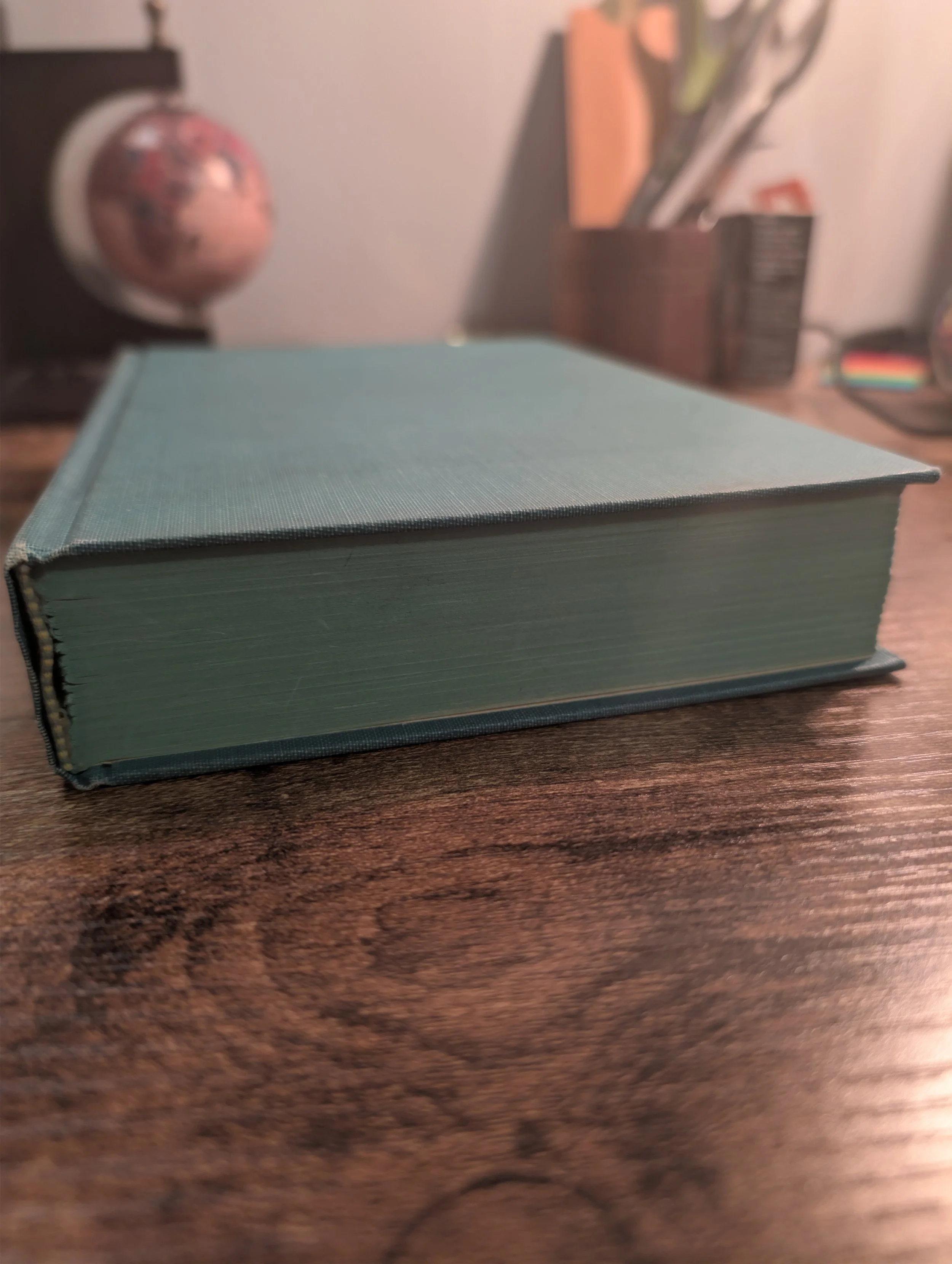
Green topstain
One caution on the cloth. You’ll see the first described as green cloth by one seller and green boards by another, and it’s tempting to read that as two different bindings. It usually isn’t. I examined a first printing under a loupe, and the Putnam cloth is woven so fine and flat that it reads as paper-covered boards at normal handling distance. A listing that says “boards” is more likely a misread than a variant, and a listing that says “cloth” may simply be quoting Currey. The material won’t settle anything on this title. The top stain, the half title verso and page 408 will.
The later Putnam printing
Currey describes this one in enough detail that it is hard to mistake once you know to look. It is bound in yellow green cloth rather than medium green, the top edge is plain rather than stained, and the verso of the half title is blank rather than carrying the book list. The jacket is priced $6.95, and there is a photograph of Heinlein on the rear panel where the first state advertises Starship Troopers.
One trap worth naming, because it catches careful people. A Heinlein photograph on the rear jacket flap is consistent with the first state. A Heinlein photograph on the rear panel is not. Those are two different surfaces, and at least one dealer listing for a genuine first printing describes the author photograph on the flap and the Starship Troopers advertisement on the rear cover. A buyer scanning quickly for "photo on the back" can talk themselves out of the right book.
Don’t take green cloth as proof in the other direction, either. Currey describes a later printing in yellow-green, but I’ve seen dealers describe Putnam third and fifth printings bound in green cloth with gilt spine lettering, which is what the first looks like at a glance. That comes from dealer listings, not from Currey or any other primary reference, so treat it as a reason for caution rather than a point of issue. Either way, the answer is the same: C22 and the 28-title half title verso are what separate a first printing from a later one.
The book club edition
This is the copy you will meet most often, and the one most frequently offered as a first. Beyond the gutter code (C23 for the BCE), the book club issue has its own internal sequence. Code 04 L was printed in January 1970 and 52 M was printed in December 1971.
There’s a quicker check than the gutter code, and sellers photograph it far more often than they photograph page 408. The book club jacket prints “Book Club Edition” at the foot of the front flap, in the spot where the trade jacket carries its $4.50 price.
Dealers also describe the book club copy with yellow spine lettering and a yellow top edge, where the Putnam trade issue has gilt lettering and a green top stain. The descriptions agree with each other, but they’re dealer listings, not a primary reference, so use the colour to screen a listing and the flap and the gutter code to decide it.
For the broader case on why book club copies get sold as firsts, and why that is usually carelessness rather than fraud, see Beware the BCE.
The restored text is a different book
The fourth book in the pile is the uncut edition, and it is genuinely a different object rather than a later printing. The 1961 text is the cut text. The longer version restores manuscript material that Heinlein's publisher had trimmed, and it appeared well after the first edition rather than as a revision he issued in his lifetime.
It is worth comparing this to a case that looks similar and is not. Clarke expanded Against the Fall of Night into The City and the Stars himself, three years later, and Currey gives each its own entry with its own first edition statement. Two books, two firsts, both authored. A posthumous restoration of a cut manuscript is a different kind of event, and it does not create a second first edition of the novel.
One more to rule out: the Taiwanese piracy
There is also a book that isn’t a Putnam product at all. Several dealers describe an unauthorized Taiwanese edition of Stranger carrying the Putnam name, the 1961 date and 408 pages, and it does get listed as a first edition. None of the primary references records it, so what follows is from dealer descriptions: it has turned up in tan or grayish-brown cloth with silver spine lettering, and also in orange cloth with gilt lettering, in a dust jacket. Because the cloth and the stamping vary, colour won’t catch it reliably. Read the imprint. Any 1961 Putnam-attributed copy at 408 pages in a binding that isn’t green deserves a second look before you buy it.
What to ask before you buy
If you are looking at a copy online, the useful request is specific rather than general. On a jacketed copy, start with the front flap and the rear panel, since most sellers photograph them already: “Book Club Edition” at the foot of the flap, or a Heinlein photograph on the rear panel, ends the question in one image. Jackets move between books, though, so a correct jacket doesn’t finish the job. Ask for a photograph of the gutter at page 408 and a photograph of the half title verso showing the book list or its absence. On a jacketless copy, those two images are the whole identification. A statement that the copyright page shows no later printing resolves nothing, and a seller who leads with that has told you they have not checked.
More on identifying Heinlein across his publishers, from the Scribner juveniles through Putnam, is in the publisher-by-publisher identification guide. Verified Golden Age first editions are in the science fiction collection.